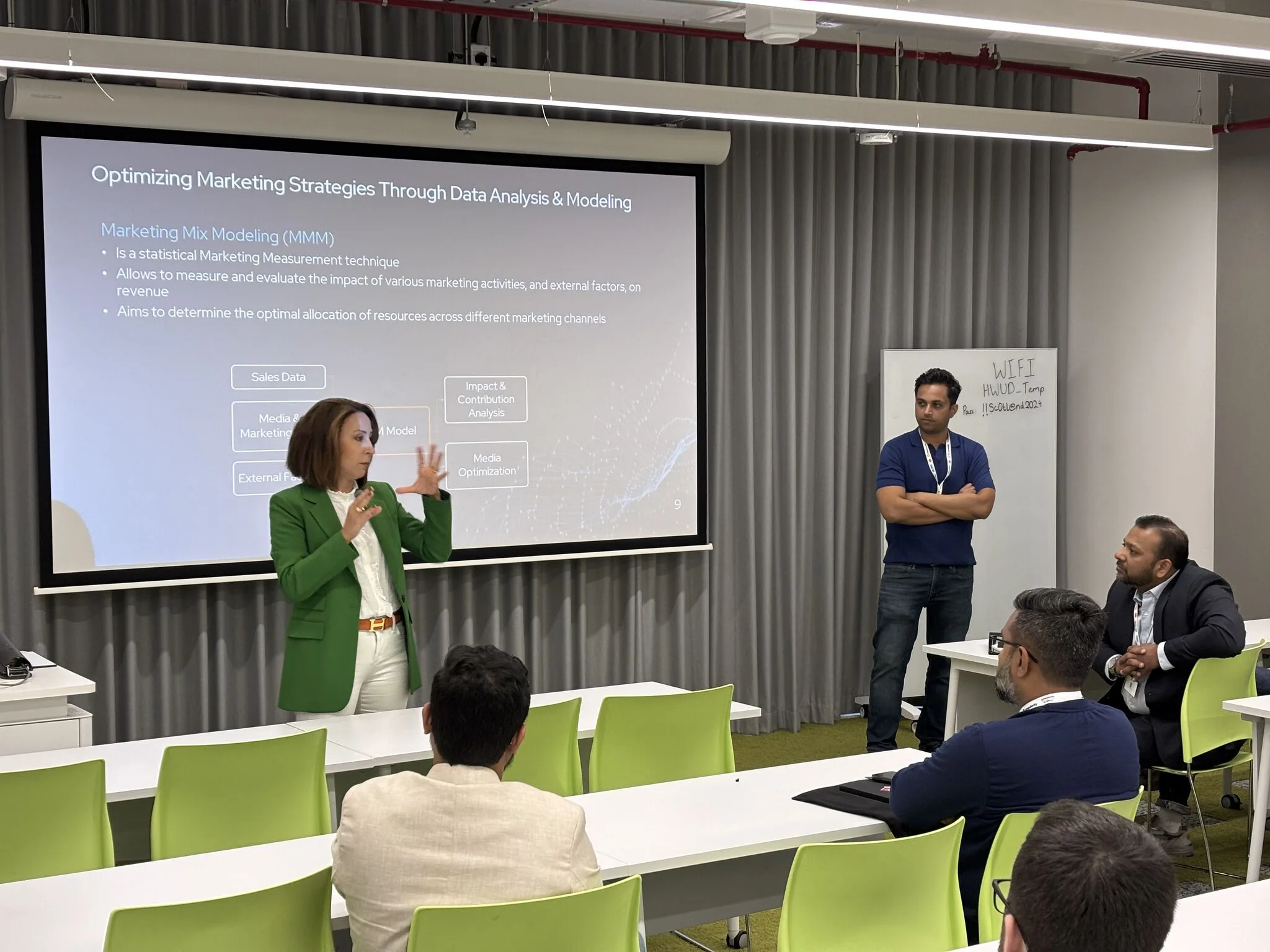
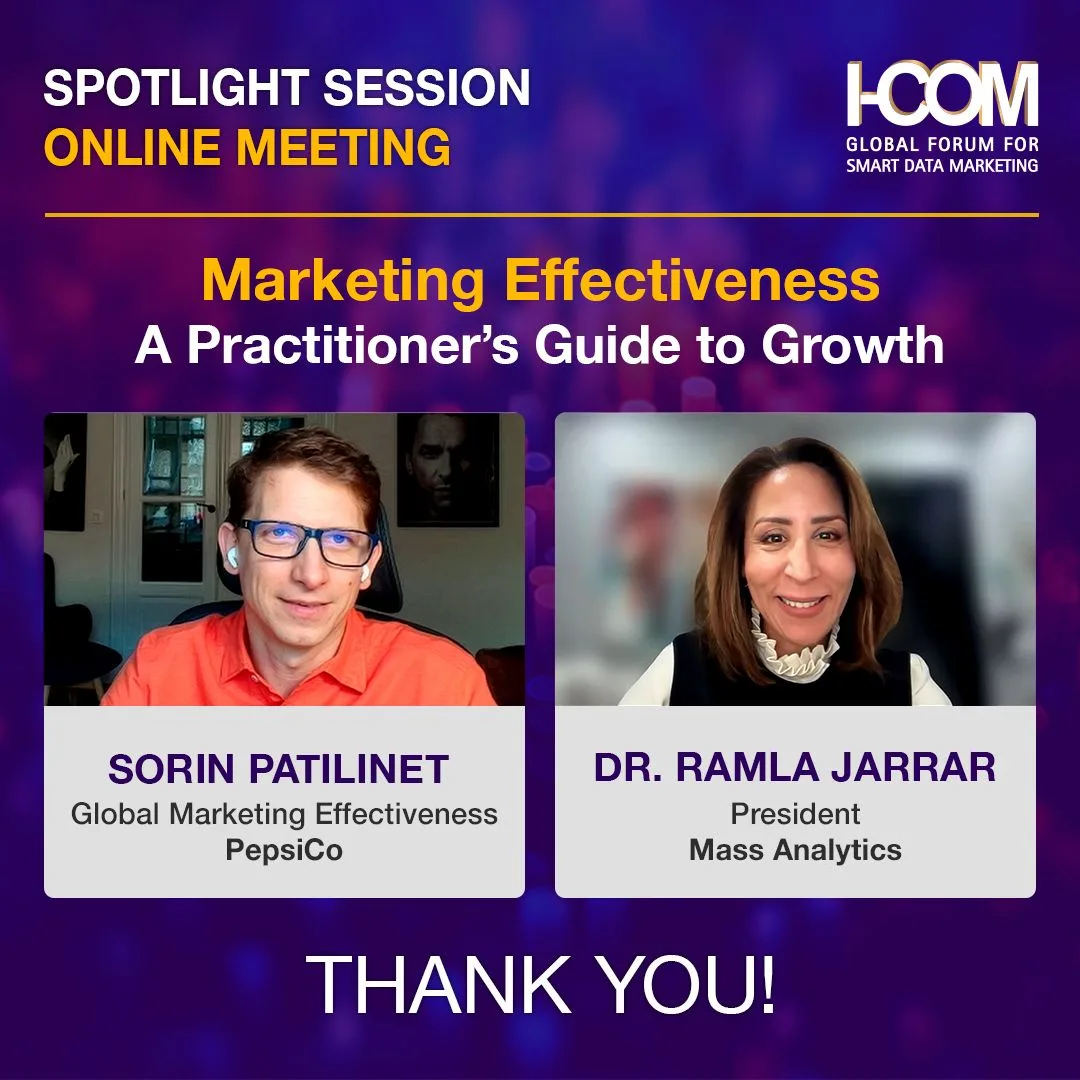
We were glad to be part of last week’s I-COM Spotlight Session on marketing effectiveness, where our President Ramla Jarrar, together with Sorin Patilinet (Global Marketing Effectiveness & Measurement Innovation at PepsiCo) moderated a closed-door discussion with senior practitioners from across the industry.
Rather than another surface-level take on “what works in marketing,” the session focused on how leaders actually think about effectiveness when real budgets, real pressure, and real trade-offs are involved.
A few themes stood out.
Marketing effectiveness is not media effectiveness.
One of the strongest points was the pushback on reducing marketing effectiveness to channel ROI or media dashboards. Marketing was framed as a system with multiple levers that work together. Strategy, product, pricing, retail, media, creative, and measurement all matter. Focusing on one while ignoring the rest is how teams end up optimizing themselves into a corner.
Efficiency is not the same thing as effectiveness.
There was real frustration in the room about how often efficiency metrics crowd out growth conversations. Chasing better ratios without asking whether the business is actually moving forward was called out as a trap. Several participants agreed that cost control is necessary, but it should not be the headline. The quality of decisions matters more than shaving decimals off a metric.
Language shapes behavior inside organizations.
A subtle but important idea was how much internal language drives outcomes. When teams talk only about ROI, they behave differently than when they talk about contribution, growth, and impact. Measurement was positioned less as a scorecard and more as a way to guide better decisions.
Measurement should start with the decision, not the data.
A lot of nodding happened around this one. Too many projects begin with “here’s the data we have” instead of “here’s the decision we need to make.” When you flip that order, the choice of method becomes clearer, and expectations get more realistic.
Marketing mix modeling still matters, but it is not magic.
MMM was widely seen as powerful for answering high-level allocation and contribution questions. At the same time, there was clear agreement that it struggles with fine-grained questions, especially around creative performance. Several voices emphasized that experimentation and MMM work best together, not in competition.
Creativity cannot be engineered away.
There was healthy tension around creativity. Measurement can protect bold ideas, but it cannot replace judgment. Trying to force every creative decision through a single model was seen as unrealistic, especially in a world of thousands of executions and fast cycles.
AI changes the game, but it does not remove responsibility.
The AI discussion was refreshingly grounded. As answers become cheap and fast, the real value shifts to asking the right questions and understanding the problem clearly. Tools help, but they don’t think for you. Several participants shared how structure and context matter more than clever prompting tricks.
Ramla’s role as moderator was to keep the discussion anchored in decision-making rather than drifting into theory or tool debates. The result was a session that stayed practical, sometimes uncomfortable, and ultimately useful.
We’re grateful to I-COM for creating the space for this kind of conversation, and for trusting Ramla to guide it. These are the discussions the industry needs more of, especially when they are allowed to happen without attribution and without performance.