

By Dr. Ramla Jarrar, President, MASS Analytics
According to MASS Analytics, paid search has always under-counted brand in MMM through endogeneity. AI search makes the bill impossible to ignore.
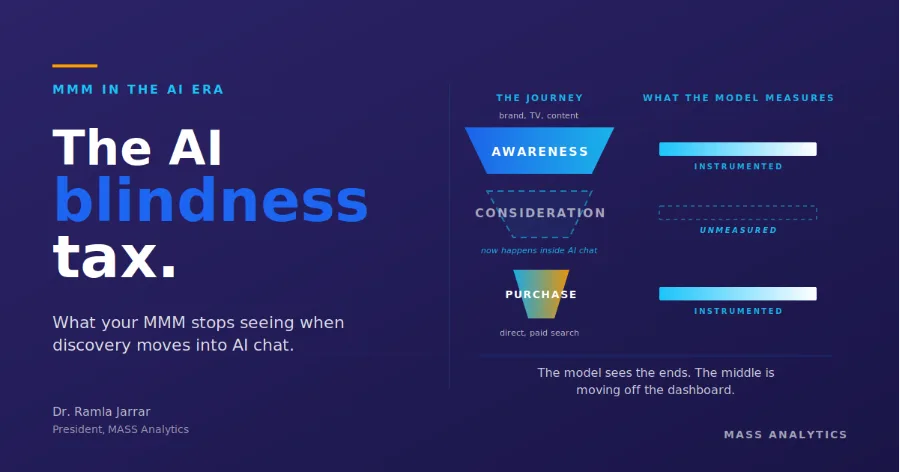
Paid search was never a clean signal
Let me start with something most senior marketers half-suspect but most MMMs in production today don’t handle properly.
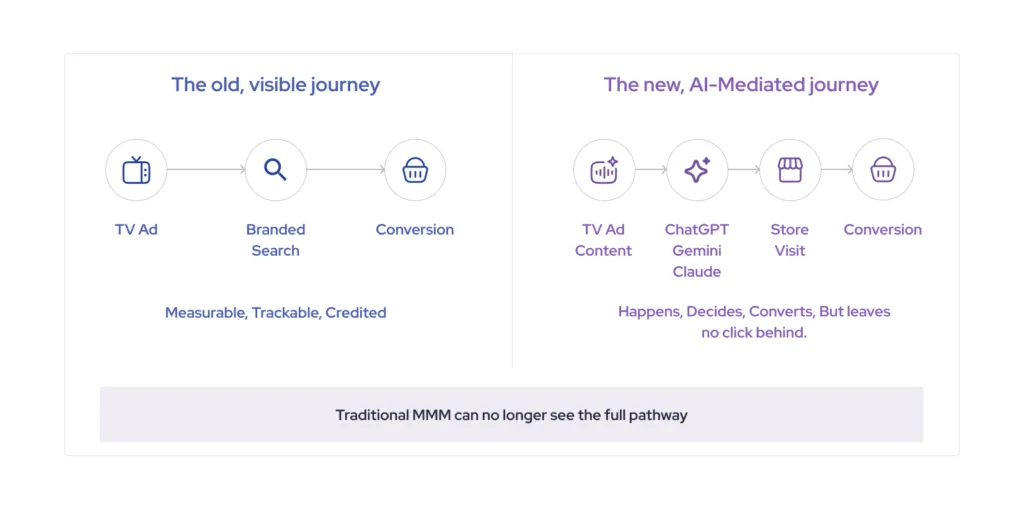
When a TV ad runs, some viewers go and search the brand by name before they buy. The branded search click is the final step in a chain that was set in motion upstream. If your model treats TV and branded search as independent variables in the same regression, the credit for that demand goes to the line closest to the conversion. Brand work disappears from the ROI calculation. Paid search looks like a hero. Brand looks like a cost centre.
There’s a technical name for this. It’s called endogeneity, and it’s a violation of the most basic assumption underneath OLS regression: that the independent variables in your equation are actually independent of each other and independent of the error term. Branded search is neither. It’s driven by TV. It’s correlated with TV. And it’s correlated with the residual of the sales equation. Run them side by side in a single OLS and the model can’t see the causal direction. It just sees correlation, closest to conversion, and assigns credit accordingly.
Most MMMs in production today still treat paid search as a clean variable. They have been over-funding search and under-funding brand for years.
We’ve been writing about this at MASS Analytics for years. The published methodology is straightforward: separate brand search from generic search, model branded search as the outcome of upstream media in a nested equation, then pass the clean exogenous component into the main sales model. The technique is called Two-Stage Least Squares. The architecture is called nested modelling. The principle is older than the method: give to each channel the commercial credit it genuinely earned, no more and no less.
I’ll say the quiet part out loud. Most MMMs in production today still treat paid search as a clean variable. They’ve been over-funding search and under-funding brand for years. The bill comes due slowly, as brand strength erodes while paid search ROAS looks great in the quarterly report.
This is the original blindness tax. It’s been there the whole time.
AI search is the forcing function
Now consumer behaviour shifts under everyone’s feet.
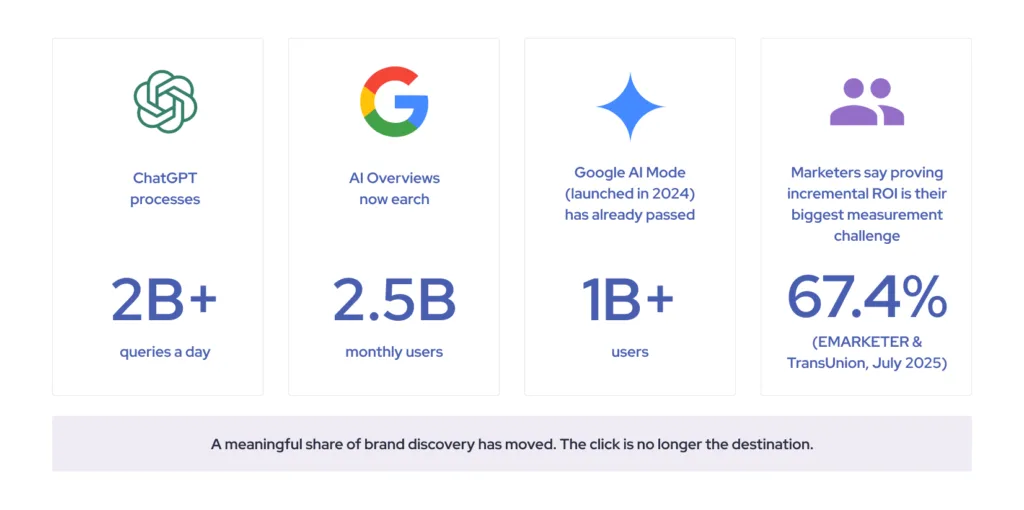
ChatGPT processes more than 2 billion queries a day. Google’s search market share dropped in late 2024 for the first time in a decade. A meaningful share of the queries that used to land in blue-link results, the long, category-research, product-evaluation queries, the ones that previously generated branded search demand, are now migrating to ChatGPT, Claude, Perplexity, Gemini and Google’s AI Overviews. The query happens. The comparison happens. The decision often happens. The click never does.
At Google I/O on 19 May, the company went further. The blue links era is officially being deprecated. Google Search is rolling out information agents that browse on the user’s behalf 24/7, plus generative UI that builds custom interactive interfaces in place of result pages. When an agent does the research and a generated interface delivers the answer, the brand-driven discovery that used to surface as a branded search query may not produce any user-visible click at all.
Google itself signalled the methodology consequence at its EMEA product conference the same week. Meridian, Google’s open-source MMM, is now integrated directly into Analytics 360, launched alongside two new causality metrics: Attributed Branded Searches for short-run impact, and Qualified Future Conversions, a Gemini-powered metric designed to connect current ad activity to brand-driven behaviour up to six months downstream. Even the platform whose business model depends on the search click is now telling marketers that the search click is insufficient on its own.
Here’s the methodology consequence, and it’s the part the GEO tooling vendors aren’t talking about.
Nested modelling was designed to recover exactly the brand-to-demand pathway that AI search is now displacing.
Brands using nested modelling correctly have a more honest view of where their growth comes from. But even nested modelling can only measure the part of the journey that’s instrumented. When the consideration step happens inside a ChatGPT conversation and resolves into direct traffic, dark social, or a store visit, the intermediate variable that nested modelling depended on, branded search volume, is no longer carrying the full signal. The instrumented share is shrinking quarter by quarter.
So the brands who never solved endogeneity were paying a blindness tax all along. Now everyone is paying one, because AI search is moving part of the brand pathway out of the model’s line of sight.
The compounding mechanism
Let me name it explicitly.
The AI blindness tax is the compounding cost of an MMM that hasn’t adapted to AI-mediated discovery. Brand and content investment that is working in-market, building demand, feeding the AI engines themselves with the citations and mentions that make a brand recommendable, becomes increasingly invisible to the model. Budget reallocations follow the model. Brand spend gets pulled toward the channels the model can still see. Brand presence weakens, including in AI engines, because brand investment is what feeds them. The model under-credits brand even more next quarter. Repeat.
This is not a one-time cost. It’s a feedback loop, and it gets more expensive every cycle until it’s broken.
It’s also paid in real budget cuts. EMARKETER and TransUnion reported in July 2025 that 67.4 per cent of marketers say proving incremental ROI is now their most pressing measurement challenge, and 28.6 per cent of marketers have had 11 to 20 per cent of their budget reallocated due to doubts about measurement accuracy. The tax is not a metaphor. It is showing up in budget conversations whether marketers name it or not.

“The blindness tax is paid in the cuts you make next quarter, based on a model that’s already measuring a smaller and smaller share of the market. “
What the MMM needs: nested modelling stays. Four things change.
Start with what doesn’t change. Nested modelling stays. Brand-search separation stays. Two-Stage Least Squares stays. The foundation MASS Analytics has been writing about for years is correct, and the AI-era recommendations build on it rather than replace it. Your MMM doesn’t need to be torn up. It needs four new inputs and a faster refresh cadence to keep up with how brand demand now travels.
AI visibility share as a new top-of-funnel variable. Citation rate, mention frequency, and recommendation share across the major AI engines belong in the same upper-funnel equation as branded search. They’re the same kind of signal: brand-driven discovery before purchase intent translates into action. One critical caveat. AI engine answers are probabilistic, so measurement must be distribution-based, not single-point. The University of St Gallen GEO research published in April 2026 makes this point precisely: don’t measure once. The MMM input is a rolling average across many sampled prompts, not a snapshot from a single query.
Content investment as a measurable channel. Long-form articles, PR placements, Reddit and Quora presence, podcast appearances, structured data, the work that historically got lumped into “brand” or “other” in the model, deserves to be broken out as its own channel with its own spend, its own response curve, and its own measured contribution. AI engines weight these heavily as sources. Brands whose content is cited are brands that get recommended. A model that can’t see content investment as a discrete input cannot guide it.
Calibration via Model Plus Experiments. When traditional inputs are weakening, calibration becomes load-bearing. Geo-holdouts on brand investment, content lift studies, and the broader Model Plus Experiments discipline that MASS Analytics has documented with Central Control are no longer a nice-to-have. They are the only way to defend brand contribution numbers in front of a CFO who has lost confidence in the search-based read. The model identifies which channels carry the most uncertainty. The experiment produces a causal lift estimate. The result becomes a Bayesian prior in the next refresh.
The coefficient your CFO can’t dismiss is one that’s been confirmed by a randomised trial, not just estimated from observational data.
Direct traffic and dark social as recovered mid-funnel variables. As more AI-mediated conversations resolve into action without a search click in between, the traffic arrives directly. Where it’s instrumented, direct traffic and dark social belong in the mid-funnel equation of the nested model. They are the partial replacement for the branded search signal that’s migrating away.
Always-On is how you actually pay the tax down
Getting the model right is necessary. Refreshing it fast enough to act on what it says is what actually pays the tax down. Keeping it independent is what makes the answer worth defending.
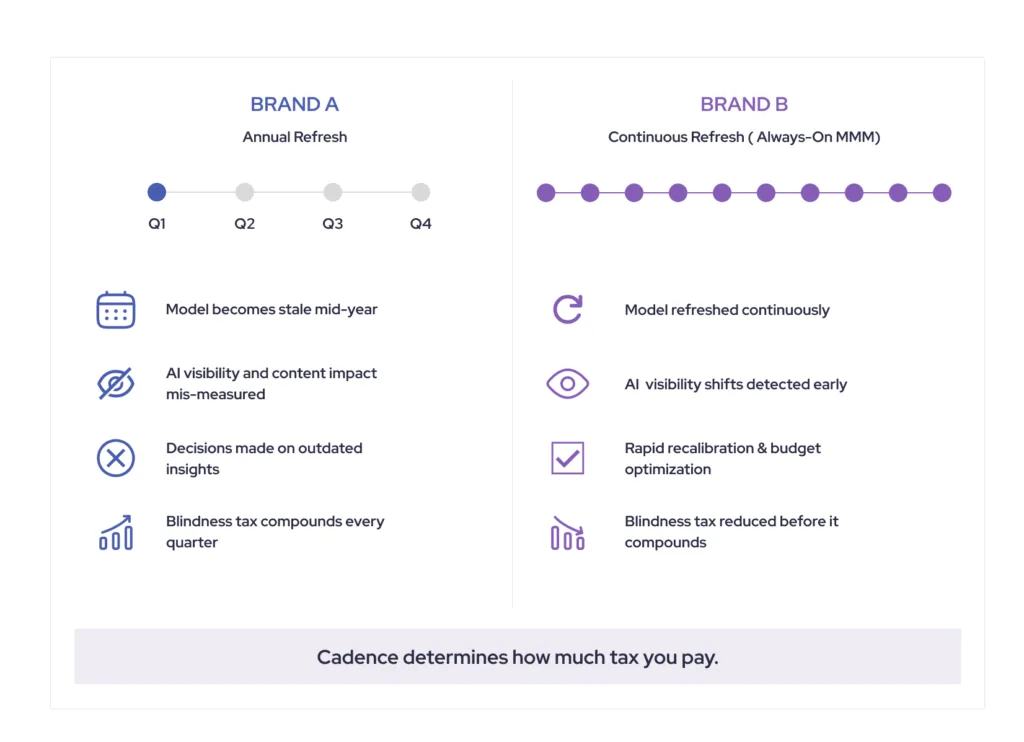
Picture two brands, both running nested modelling with the four new inputs added correctly. Brand A refreshes annually. Brand B refreshes continuously. By month four, Brand A is already making mid-year decisions on a model that has been wrong about AI visibility and content contribution for a third of a year. The methodology is correct in theory. The cadence makes it stale in practice. Brand B catches the same shifts within weeks, recalibrates, and the tax never gets a chance to compound.
Always-ON MMM doesn’t make the model better. It makes the model timely. In a stable channel mix that distinction was a nice-to-have. In a market where consumer behaviour is migrating mid-quarter, from search to AI engines, from clicks to off-platform discovery, timeliness is what separates an MMM that pays down blindness tax from one that just measures it more accurately while still bleeding.
There’s a second reason cadence matters more this year. Every major platform now has its own MMM product. Google’s Meridian sits inside Analytics 360. Meta has Robyn. Amazon has its own. Each is asking marketers to trust the platform’s measurement of the platform’s own performance. That is not a category MMM was designed to live in. Always-ON MMM, your data, your model, refreshed continuously, not produced by any of the media owners whose ROI it judges, is the structural answer to a problem the platforms cannot solve for you. The conflict of interest is unavoidable.
Methodology determines the size of the tax per refresh cycle. Cadence determines how many cycles compound before the next correction.
What this looks like in practice
A nested modelling case study we’ve published illustrates what the methodology does in a real budget decision. A retail brand running heavy TV alongside branded search built an initial OLS model that handed the commercial uplift to the search line. A nested specification recovered the causal direction. Branded search during TV windows rose sharply, but the uplift was TV’s demand surfacing downstream. The corrected model attributed credit accurately, and the budget decision that followed was counterintuitive but defensible: branded search spend was cut during TV peaks to protect margin, while unbranded search was increased to capture new demand. Total sales uplift from the reallocation was 12 per cent.
Run the same engagement today with AI visibility share added as a top-of-funnel input alongside branded search, and the decision shifts again. Part of what TV used to drive into branded search now drives into AI mentions, content engagement, and direct traffic. A model that doesn’t see those signals will cut TV faster than it should. A model that does see them will rebalance with more confidence, faster, and in a direction the CFO can sign off on.
The cost of waiting
Brand and content investment isn’t losing its impact. It’s losing its old measurement pathway, and the cleanest replacement signals are sitting outside most MMMs in production today.
Every quarter spent waiting is a quarter of compounding blindness tax. The CMOs who get ahead of this will reach their next budget round with an MMM that separates brand from generic search, accounts for AI-mediated discovery, has brand contribution calibrated against experiments rather than a fading proxy, and refreshes fast enough that the next cycle’s tax never gets a chance to compound.
The question I’d ask any CMO reading this: how many quarters of blindness tax has your model already paid, and how many more will it pay before the next refresh?
This piece is a focused look at paid-search endogeneity specifically. For the broader picture of what AI does and does not change across marketing mix modeling, see AI marketing mix modeling.