

A perspective from MASS Analytics on learning marketing mix modeling: the datasets, tools, and courses that matter, and the order that makes them stick.
- ✓A first marketing mix model needs a spreadsheet, three years of weekly data, and no one’s permission.
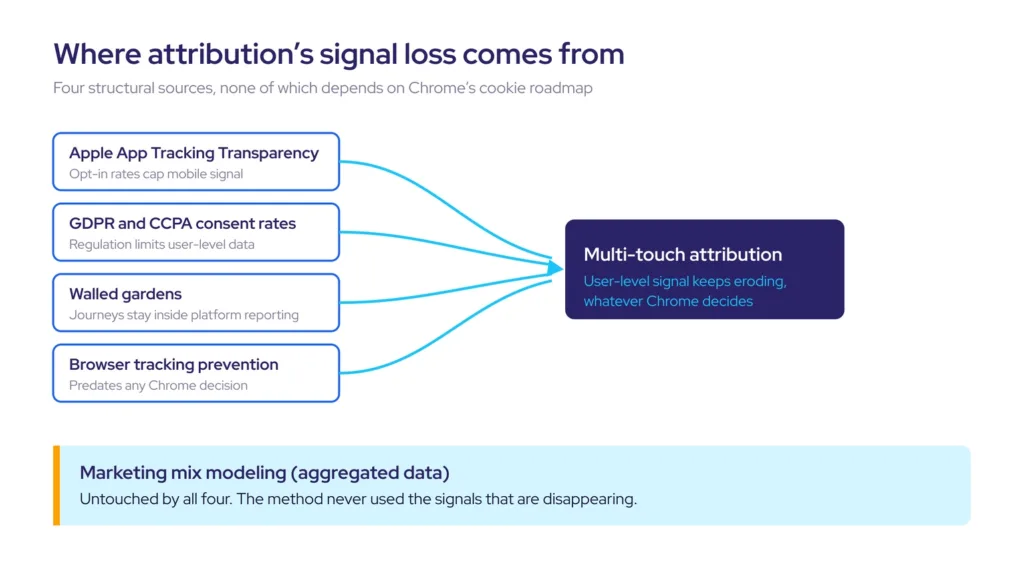
- ✓MMM’s privacy resilience is structural: the method never used the tracking signals that consent rules and walled gardens keep eroding.
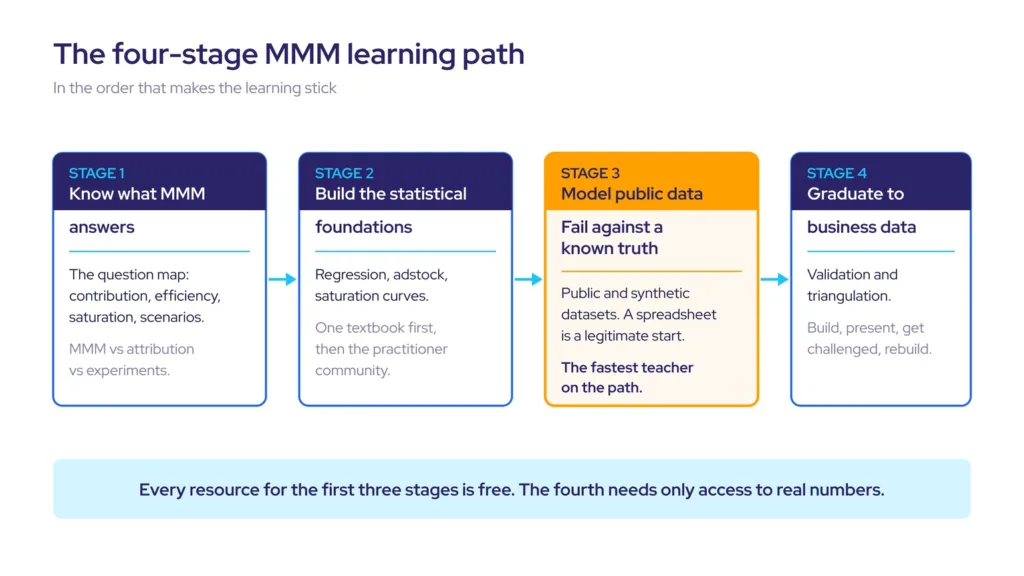
- ✓The learning path has four stages: understand the question map, build the statistical foundations, model public data, then graduate to business data with validation discipline.
- ✓46.9% of US marketers plan to invest in MMM over the next year, and only 22% of organizations convert model insights into timely action well. Trained practitioners are the scarce resource.
The learning path that needs no one’s permission
Learning marketing mix modeling requires a spreadsheet, three years of weekly data, a working grasp of regression, and the discipline to validate what gets built. Everything else on the typical resource list is optional.
MASS Analytics has spent two decades building marketing mix models and training the teams who run them. The question that opens most of those engagements is rarely technical. It is where to start. This guide is the answer we give: a staged path, with the free resources placed where they belong in the sequence. It also offers an honest read on what each one is for.
The demand side is doing its part. Nearly half of US brand and agency marketers (46.9%) plan to invest in MMM over the next year. More of them also rate MMM the most reliable measurement methodology (27.6%) than rate multi-touch attribution that way (19.4%), per a July 2025 EMARKETER and TransUnion survey. Gartner launched a dedicated Magic Quadrant for MMM solutions in 2024 and expanded it in 2025. The people who learn the discipline properly are walking into that demand.
Marketing mix modeling, defined for people who will build one
Marketing mix modeling is a statistical technique that measures how each marketing activity drives a business outcome like sales. Alongside media, it also accounts for pricing, promotions, distribution, and external factors. It works on aggregated historical data. No individual is tracked, no cookie is read, no consent banner is involved.
In practice MMM does three jobs. Measurement tells you what each channel contributed. Optimization tells you where the next dollar is best spent, based on each channel’s response curve. Forecasting projects what a given plan will deliver before the budget is committed.
That is the whole method in three sentences. The craft sits in the data and in the transformations that make media behave in the model the way it behaves in reality (adstock for memory, diminishing returns for saturation). It also sits in the judgment to reject a statistically attractive model that is commercially wrong.
The Comprehensive MMM Guide is the fuller foundation this article assumes; the sections below point at it rather than repeat it.
Stage 1: Know what MMM answers and what it does not
Before modeling anything, learn the question map. MMM answers contribution, efficiency, saturation, and scenario questions at the channel and campaign-group level. It does not answer individual-level questions, and it does not replace a live experiment when a single intervention needs causal proof.
MMM versus multi-touch attribution in 2026
The comparison with multi-touch attribution matters here, and the 2026 version of that story is worth getting right. Google ultimately kept third-party cookies in Chrome, and it changed very little. Instead, the signal loss undermining attribution is structural. It comes from Apple’s App Tracking Transparency, consent rates under GDPR and CCPA, walled gardens that keep journeys inside their own reporting, and browser tracking prevention that predates any Chrome decision. Google kept third-party cookies, and attribution kept degrading anyway. A method built on aggregated data holds its ground because it never depended on those signals.
“Google kept third-party cookies, and attribution kept degrading anyway.”
Experiments sit on the other flank. A well-run lift test gives clean causal evidence for one channel at one moment. However, it is expensive to run at scale and hard to run rigorously. Mature programs use MMM as the backbone and experiments as calibration inputs, with attribution kept for tactical, in-platform decisions.
Real cases that make the question map concrete
The fastest way to make the question map concrete is to read real cases. A leading CPG brand used MMM to discover that BOGOF promotions delivered the biggest sales uplift while shallower discounts were more profitable. As a result, it rescheduled its promotional calendar accordingly. A B2B software company modeled 5 products across 8 countries and found paid search carried the UK while email carried Canada. A sportswear retailer measured its omnichannel strategy and lifted media-driven revenue by 14%. In each case the output was a decision.
For the executive view of why adoption keeps climbing, consider a 2025 Harvard Business Review Analytic Services study. It found 68% of organizations turning to MMM for a sharper focus on marketing ROI, and 54% citing channel complexity. The same study found only 22% of organizations genuinely effective at converting model insights into timely action. That gap is where trained practitioners are scarce.
Stage 2: Build the statistical foundations
MMM rests on econometrics, regression, and time series analysis. A PhD is not required. What is required is understanding what a coefficient means and why multicollinearity ruins naive models. Beyond that, it means knowing how adstock and saturation transformations turn raw spend into something a regression can honestly measure.
Four textbooks built this field and still teach it best: Market Response Models and the Handbook of Marketing Analytics (both Hanssens et al.), Market Response and Marketing Mix Models (Bowman and Gatignon), and Modeling Markets (Leeflang, Pauwels et al.). Start with one. Market Response Models is the one we hand new analysts first.
For video-first learners, the MASS Analytics MMM Masterclasses walk the full project workflow episode by episode. The Measure Up podcast (Jim Gianoglio and Simon Poulton) is the best running conversation in the field. Meanwhile, the MMM Hub Slack community is where practitioners compare notes between releases. The Advertising Research Foundation and the Marketing Science Institute mark the research frontier.
For long-term measurement specifically, Binet and Field documented a shift toward brand investment in The Long and the Short of It. That shift is still reshaping what models are asked to measure. Approaches like nested modeling exist to capture brand effects a single-equation model misses. For a worked example, see how a consumer health brand revalued its brand media from $1.00 to $2.30 per dollar.
Stage 3: Build a first model on public data
Reading about MMM teaches vocabulary. Building one teaches the discipline. There is no need to wait for access to company data; the community has published enough to start this week. The fastest way to learn MMM is to model a public dataset badly, then find out why.
“The fastest way to learn MMM is to model a public dataset badly, then find out why.”
Public datasets to start with
Four sources cover the learning arc. The Conjura eCommerce dataset offers real multi-brand data from close to 100 online brands, suited to digital-channel modeling. The dataset collections curated by Forecastegy (credit to Mario Filho) mix real and simulated series. The Bookworm dataset is the one our Udemy course project is built on, so it can be followed with instructions or attacked freestyle. And synthetic generators like SiMMMulator produce media time series with known ground truth. That is the single most instructive way to learn, because when the true answer is known, the model’s errors become visible and specific.
Download the Bookworm dataset
The practice dataset from our Learn by Doing course is free to download from our site: Practice Dataset. Model it freestyle, or enroll in the course and follow the guided build on the same data.
Tooling and data requirements for a first model
Tooling for this stage is deliberately humble. A spreadsheet is a legitimate first modeling environment. Excel and Google Sheets handle the core regression. In addition, building the transformations by hand teaches what every automated tool does on the analyst’s behalf. The ceiling on data volume and optimization arrives quickly; hitting that ceiling is part of the curriculum. A first marketing mix model needs a spreadsheet, three years of weekly data, and no one’s permission.
“A first marketing mix model needs a spreadsheet, three years of weekly data, and no one’s permission.”
On data expectations, the working standard for a single-market model is three years of weekly data. That is enough for seasonality to repeat and media to vary. The requirement relaxes when the data gains cross-sectional structure. Three years of national weekly data is roughly 156 observations; the same brand across 100 stores over 18 months is roughly 7,800. Public datasets rarely offer that luxury, which is fine. Learn on what exists.
Stage 4: Graduate to real business data and validation
Real data is where the discipline earns its keep. Company data arrives incomplete, misaligned, and politically loaded. The most common failures in MMM practice are omissions rather than statistics. In other words, a model missing an important driver quietly hands that driver’s effect to whatever variable happens to correlate with it.
This is the stage where validation stops being a checkbox. Fit statistics and out-of-sample checks are table stakes. The harder test is commercial plausibility: if a channel measurement contradicts everything the business knows, that is a prompt to investigate rather than a finding to present. When platform-reported ROAS says 560% and the model says 400%, the divergence is information. Triangulating model results against lift tests and platform reporting is the first step. Then, calibrating against ground truth as outcomes accumulate is how a model earns the right to move budget.
This is also the stage to stop working alone. Present results to someone who will push back. The modeling is learned in weeks; the judgment that survives a CFO’s questioning takes longer, and there is no dataset for it. Build, present, get challenged, rebuild.
MMM tooling in 2026
Beyond the spreadsheet, tooling comes in two tiers, and the honest comparison matters more than any feature list.
Open-source packages
Open-source packages have matured substantially. Meta’s Robyn has the most active community. PyMC-Marketing has become the serious Bayesian option with strong documentation. Google’s Meridian brought reach and frequency measures and search-volume integration into the open-source tier, addressing endogeneity questions older packages ignored. All three are genuinely capable. However, all three carry the same fine print: the analyst is alone when something breaks, and the package will not flag a wrong specification. Open-source MMM packages are free to download and expensive to be alone with.
“Open-source MMM packages are free to download and expensive to be alone with.”
Specialist marketing mix modeling software
Specialist marketing mix modeling software is the tier where the tool comes with accountability. That means documentation, support, training, and people who have seen the failure mode before. Our platform line runs from MassTer PACE, the Always-On system that keeps models continuously refreshed, through the Studio, Mind, and Flow products covering modeling, insight activation, and data pipelines. We build specialist software, so read this paragraph knowing that. The cost of specialist platforms is real. So is the cost of six months of analyst time spent debugging a free package alone.
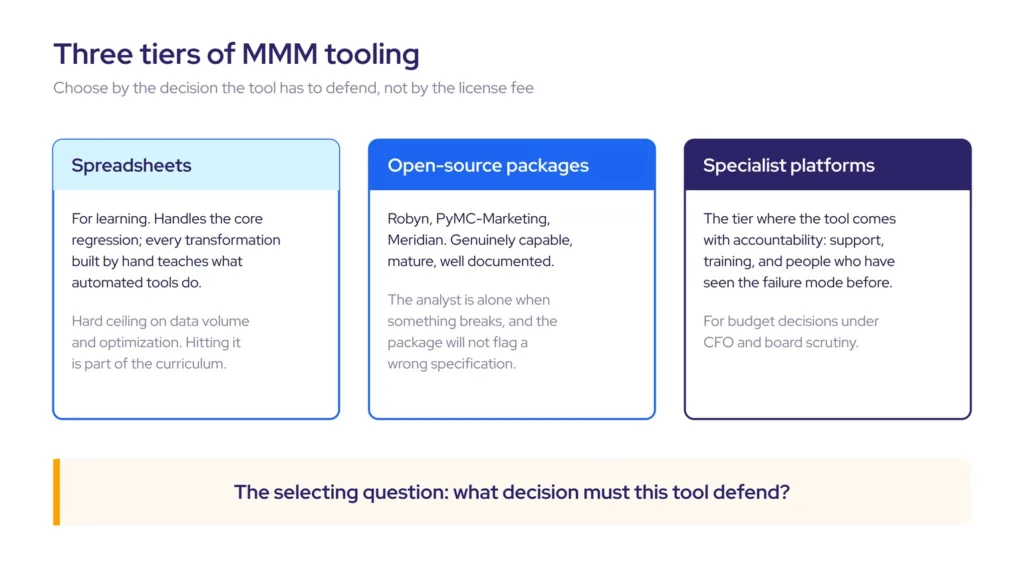
A learning project belongs in a spreadsheet or an open-source package. A budget reallocation the CFO will interrogate belongs in tooling with someone standing behind it.
Learn MMM with MASS Analytics
Everything above is the self-directed path. For readers who would rather follow a curriculum that is already sequenced, we built three.
The MMM education pack series on YouTube teaches the discipline one pack at a time, starting with Marketing Mix Modelling Fundamentals and the MMM Building Blocks pack. A new pack lands every week. Each video is short, specific, and built from the same material we use to train client teams. The full set lives on our channel playlists page.
The same curriculum runs as a hands-on Udemy course, Fundamentals of Marketing Mix Modeling: Learn by Doing. Students build a real model on the Bookworm dataset from this article, end to end. It is the fastest route from reading about MMM to having built one.
For a structured course rather than a self-directed path, the MMM Learning Academy hosts the free MMM Fundamentals course. The End-to-End Course is the hands-on progression from it.
Frequently asked questions about learning marketing mix modeling
Marketing mix modeling is a statistical method that measures how each marketing activity, along with pricing, promotions, and outside factors, drives sales. It uses aggregated historical data rather than tracking individuals, so it works without cookies or user-level data. The output tells you what each channel contributed and where the next dollar is best spent.
The working standard is two to three years of weekly data covering sales, media spend or exposure by channel, pricing, promotions, and distribution. Three years is better because the model needs to see seasonality repeat. If your history is shorter, you can still start, but expect wider uncertainty ranges and validate more aggressively.
Yes, and it is a legitimate place to start. Excel and Google Sheets handle the regression analysis at the core of MMM. Building one manually also teaches you what automated tools do on your behalf. You will hit limits on data volume, transformations, and optimization. That is the point at which teams move to open-source packages or specialist software.
MMM works top-down on aggregated data to measure every driver of sales, including offline media and external factors, with no user tracking. Multi-touch attribution works bottom-up on user-level touchpoints, which makes it granular. However, it depends on tracking signals that consent rules and walled gardens keep eroding. Mature teams use MMM as the backbone and MTA for tactical refinement.
A motivated analyst with basic statistics can build a first model on a public dataset within a few weeks. Reaching the level where your models survive stakeholder scrutiny typically takes six to twelve months of building, validating, and presenting real models. The modeling is learned faster than the judgment. Structured courses compress the early stages considerably.
Not to start. The foundations are econometrics and regression, which many analysts already hold, and modern software automates much of the mechanical work. What you do need is someone accountable for model quality who understands the business context. Larger programs benefit from dedicated modelers, but the shortage in most MMM programs is judgment, not job titles.
Start before it feels comfortable
The path is four stages: understand the question map, build the statistical foundations, model public data until the mistakes teach, then graduate to data that carries consequences. Every resource for the first three stages is free and named above. The fourth requires only that someone lets you near real numbers. Analysts who arrive with a built model tend to get that access quickly.
So the question worth taking into the week is a short one: if a public dataset and a spreadsheet are all it takes to start, what is the reason for not having a model by the end of the month?