
Why the measurement-to-action gap is the real MMM problem, and what a decision-grade program looks like in practice. By Dr. Ramla Jarrar, MASS Analytics.
- →Most organizations that struggle with MMM are not struggling with the model. They are struggling with what happens after it.
- →There are five distinct failure modes that stop measurement from changing decisions, and none of them are statistical.
- →The difference between MMM as a reporting tool and MMM as a decision engine comes down to organizational ownership, not model quality.
- →A practical framework for closing the insight-to-decision gap, including the credibility ladder and the operating standard the CMO must own.
- →Why the CMO, not the analytics lead, is the only role positioned to fix this.
Most organizations with an MMM program already know what their model says. They know which channels are overfunded, where saturation is kicking in, and roughly what a ten-percent reallocation would do to revenue. They have the insight. What they do not have is a decision that follows from it.
I have been doing this work for over twenty years, across more than twenty countries. The conversations I have with senior marketers rarely start with ‘our model is wrong.’ They start with ‘our model is right but nothing changes.’ That is a different problem, and it requires a different solution.
This article is about that gap. It covers why measurement without organizational ownership produces nothing, what separates an MMM reporting tool from an MMM decision engine, and what a practical measurement-to-action framework looks like. If your model is sound but your budget conversations still run on gut feel, this is for you.
“A model that does not change a decision is an expensive academic exercise. The commercial success of an MMM program is measured by the strength of the second arrow: the one that runs from model output back into the business.”
The Insight-to-Decision Gap Is an Organizational Problem, Not a Modelling One
The gap exists because most MMM programs were commissioned to answer a question for the analytics function and delivered in a format the planning function cannot act on. The model is built at one level of granularity. The planning conversation happens at another. The recommendation cannot be implemented because nobody in the room where the plan is approved has the authority to act at the level the model speaks.
In our work with a leading footwear and apparel group, the pattern was textbook. A rigorous quarterly MMM program produced results for the executive team. Those results produced no traction with the regional planners and agency partners who set the actual media plans. The diagnosis: the report was built at brand-portfolio level while the planning conversations happened at platform and tactic level. The same model that had produced a quarterly slide nobody used began producing decisions every cycle once the taxonomy was rebuilt to match the level at which plans were actually set.
The model had not changed. The organization had not changed. The reporting layer had changed. That is the gap.
Reporting fails when the reporting groupings do not match the buckets the budget holder plans against. The remedy is structural, and it happens before any data is processed.
Five Failure Modes That Stop Measurement from Moving Budgets
Adoption failures across MMM programs fall into five patterns. Almost every brand that is struggling with this is dealing with at least three of them simultaneously. None of them are problems of model quality. They are problems of organizational design.
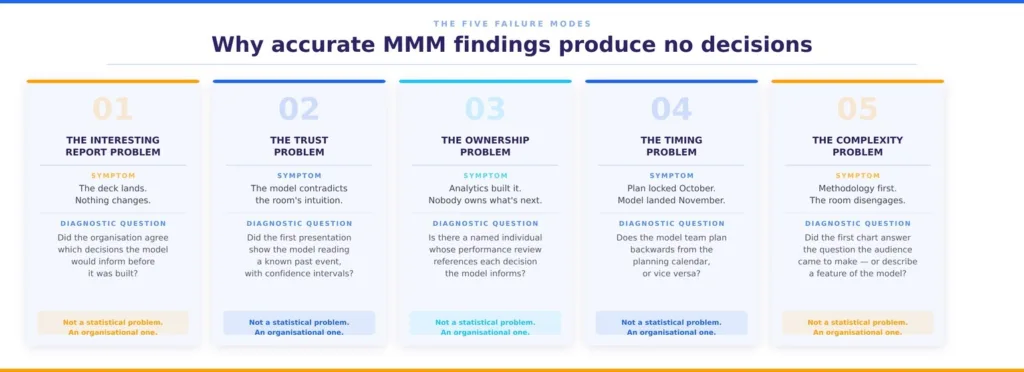
- The interesting-report problem. The deck lands. Nothing changes. The diagnostic question: did the organization agree, in writing, which decisions the model would inform before the model was built?
- The trust problem. The model contradicts the room’s intuition. The room defends the intuition. The diagnostic question: did the first presentation show the model reading a known past event, with confidence intervals visible?
- The ownership problem. Analytics built it. Marketing received it. Nobody owns what happens next. The diagnostic question: is there a named individual whose performance review references each recurring decision the model is meant to inform?
- The timing problem. The plan was locked in October. The model landed in November. The diagnostic question: does the model team plan backwards from the planning calendar, or vice versa?
- The complexity problem. Methodology comes first. The room disengages before findings arrive. The diagnostic question: in the last presentation, did the first chart answer a question the audience came to make, or describe a feature of the model?
These five patterns share a single cause: the absence of an agreed standard that names the decisions, the owners, the cadence, the trust-building tests, and the communication discipline before the model is commissioned.
The five failure modes are independent of model quality, vendor, and industry. They are problems of organisational design, and they are the CMO’s to solve.
Why Only the CMO Can Fix This
Each of the five failure modes lives in a gap between two functions. Gaps, by definition, belong to no function unless someone claims them. The head of analytics can build the model but has no authority over the media planning calendar, no seat in the agency relationship, no ability to require that finance share its revenue definitions.
The CMO sits at the intersection of four things no other role combines: budget authority, decision authority, cross-functional sightline, and two-directional accountability. The operating standard is therefore a CMO product.
Ownership does not require the CMO to understand Bayesian regression. It requires four leadership tasks: name the operating standard as a priority; sign the document that defines it; defend it against the first ten challenges; make a small number of visible decisions that demonstrably ran through the operating standard rather than around it.
What an MMM Decision Engine Looks Like in Practice
The operating standard has four artefacts: a stakeholder map, a decision map, a contradiction rule, and the credibility ladder.
The credibility ladder is the part most organizations skip. Trust in the model is not declared; it is earned one cycle at a time.
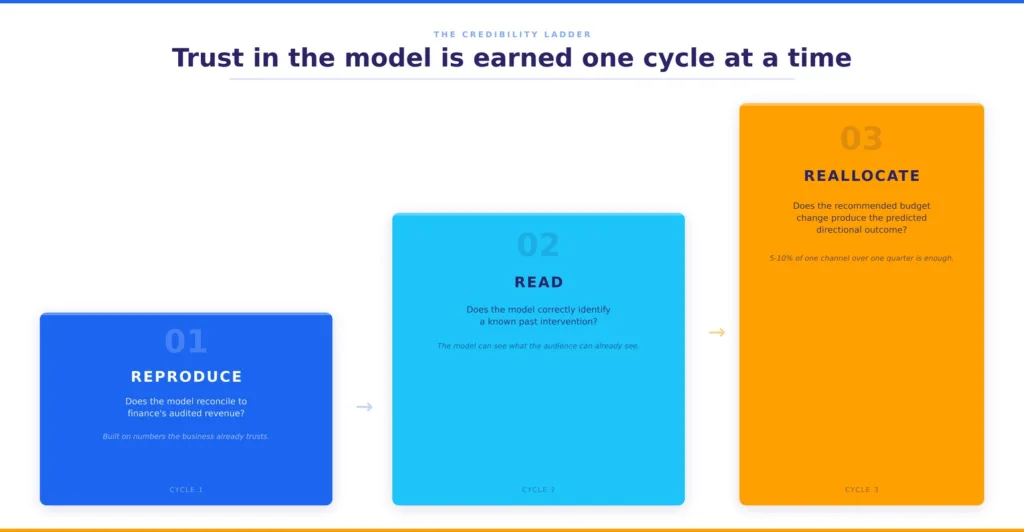
- Cycle 1: Reproduce. Does the model’s read of the last full year reconcile to finance’s audited revenue, by quarter and by region?
- Cycle 2: Read. Does the model correctly identify a known past intervention, at roughly the right scale and timing, with confidence intervals that contain the audience’s best estimate?
- Cycle 3: Reallocate. Does the budget change the model recommends, when applied, produce the directional outcome the model predicted? Five to ten percent of one channel’s budget, over one quarter, is enough to produce a testable signal.
Most adoption failures happen because a CMO under pressure presents a cycle-three finding in cycle one. The room declines. The model is discredited — not because it is wrong, but because the order of trials was wrong.
Trust in the model is not declared. It is earned one cycle at a time. Reproduce, Read, Reallocate. A CMO who has cleared all three has an operating standard the room will defend in front of the CFO and the board.
Aligning with Finance Is the Move Most Teams Leave on the Table
Three moves close the CMO–CFO gap without requiring technical persuasion. First, shared definitions: a one-page document, signed jointly before the first measurement cycle, fixing what every term means. Second, shared cadence: the CFO never reads the measurement report cold. Third, shared sign-off: the annual measurement plan carries both signatures.
A measurement program that finance has co-authored is one finance will defend.
The Maturity Model: Where Most Programs Actually Sit
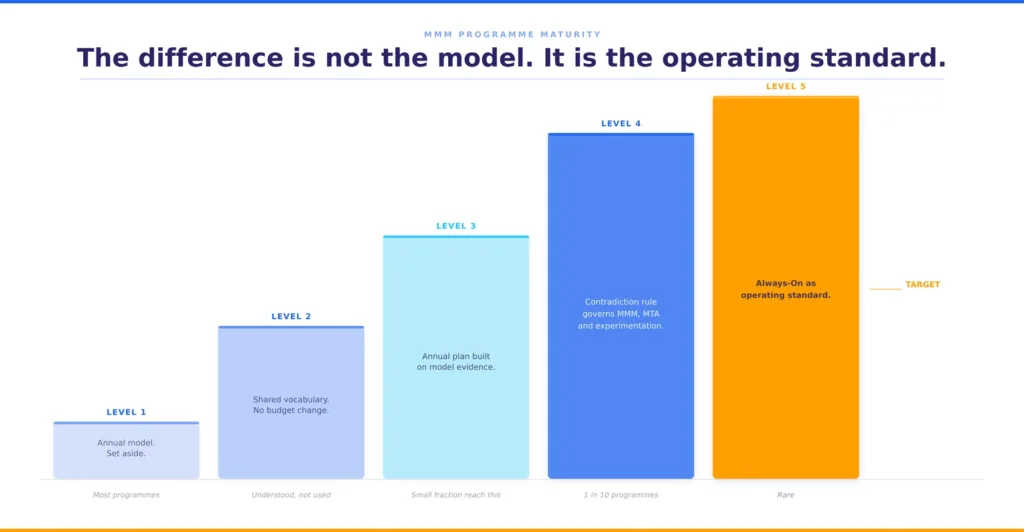
- Level 1: A model is presented annually and set aside. Most programs live here.
- Level 2: Shared vocabulary, but no budget change.
- Level 3: The annual plan is built on model evidence.
- Level 4: The contradiction rule actively governs three methods: MMM, attribution, and experimentation.
- Level 5: Always-On as the operating standard. Rare.
The difference between levels is not a technology question. It is a leadership question.
What Great CMOs Need: An Executive Playbook for Modern Marketing Mix Modelling
By Dr. Ramla Jarrar and Dr. Firas Jabloun. Be the first to receive it.
Frequently Asked Questions
We have an MMM program and our findings seem accurate. Why isn’t anything changing?
Accuracy is necessary but not sufficient. The most common reason accurate findings produce no decisions is the timing problem: the model delivers after the plan is locked. The second most common is the ownership problem: nobody’s performance review references the decision the model is meant to inform. Audit those two before looking at the model itself.
Our analytics team wants to present the full methodology before findings. Is that wrong?
For internal stakeholders who have requested the methodology briefing, a separate technical session works well. For any presentation to a budget holder, methodology first is the complexity problem in action. Move methodology to an appendix or a parallel track.
How do we handle it when the model contradicts what our agency is recommending?
You need a contradiction rule before the first contradiction arrives, not during it. The rule specifies: which method is primary for which class of decisions, what constitutes a material disagreement, and what happens when one exists.
The Operating Standard Is the Only Deliverable That Compounds
The model produces evidence. The operating standard turns evidence into a decision. The decision turns into a result. Each step depends on the one before it, and the CMO is the role that holds all four together.
The question that reveals where your program actually sits is not ‘how good is our model?’ It is ‘which three decisions did our last model cycle change?’ If you cannot name three decisions, the gap is not in the model. It is in the operating standard. And that is a leadership problem with a leadership solution.
The question that diagnoses where your program sits: which three decisions did your last model cycle change? If you cannot name them, the gap is in the operating standard, not the model.
Ready to close the insight-to-decision gap?
Talk to MASS Analytics about building an MMM decision engine that turns measurement into action — every cycle.
Key Takeaways
- ✓The insight-to-decision gap is organizational, not statistical. Organizations with accurate MMM findings and unchanged budgets are not failing at modelling. They are failing at operating standard design.
- ✓Five failure modes block adoption — none are statistical. The interesting-report problem, the trust problem, the ownership problem, the timing problem, and the complexity problem are organizational design failures the CMO must solve.
- ✓Trust in the model is earned one cycle at a time. Reproduce, Read, Reallocate. Skipping the sequence loses the audience before the findings land.
- ✓Finance alignment requires shared definitions, shared cadence, and shared sign-off. Most CMOs attempt only one of these.
- ✓The diagnostic question that reveals where your program sits: which three decisions did your last model cycle change? If you cannot name them, the gap is in the operating standard, not the model.