MASS Analytics president Dr. Ramla Jarrar on why a finished Marketing Mix Model only becomes a budget decision when you can test the plan before you commit the spend.
- →The gap between a finished MMM model and a committed budget, and why it stays open
- →Simulation and optimization as two different questions, run in opposite directions
- →Why scenario testing belongs before the spend, not after the quarter closes
- →The external factors, competition and macro conditions, that decide a year and rarely enter the plan
- →What it takes for a model to become a decision engine your finance team will defend
A model is not a plan.
Most marketing teams I meet have a Marketing Mix Model they trust. Then they open a spreadsheet to plan the budget.
The model that cost months to build sits in a report. Yet the decision that spends the money happens somewhere else entirely, in a planning file the model never touches.
In short, that gap is the most expensive thing in marketing measurement, and almost nobody names it.
A Marketing Mix Model measures what already happened. A plan commits money to what happens next. Those are two different jobs, and most teams only own the first one.
The model answers a question about the past
A Marketing Mix Model is built in the past tense. It reads historical spend and sales and tells you what drove last period’s revenue: the contribution of each channel, the return on each dollar, the point where each curve flattens. In other words, every one of those answers is backward-looking, and every one of them is useful.
A budget is the opposite: it is a forward-tense instrument that commits money to a version of next year that has not happened yet.
The handoff between the two is where teams lose the value they paid for. Yet the model produces a clean read of the past, even when the data was cleanly prepared and pipelined in MassTer Flow and carefully built in MassTer Studio. Then the planner rebuilds it by hand in a spreadsheet, drops the response curves, and plans on instinct dressed up as a grid. As a result, the rigor stops exactly where the money starts.
Simulation and optimization are two questions, not one
Once the model is live, it can answer two forward questions. They sound similar. They are not.
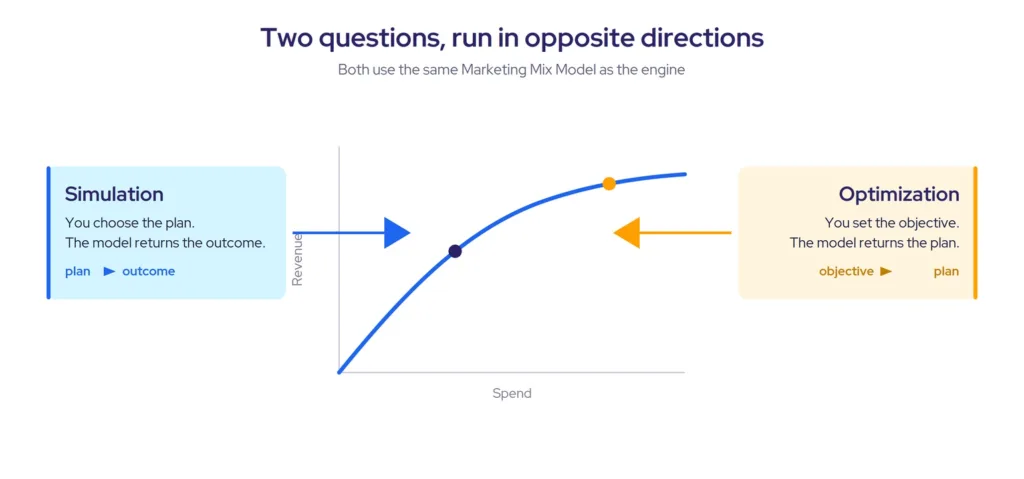
Simulation asks what a chosen plan delivers. You set the spend, the channel mix and the timing, and the model returns the revenue that plan should produce.
In contrast, optimization runs the same machinery in reverse. You set the objective, say Maximize Revenue, and the constraints, total budget, date range, channel-level floors and ceilings, and the model returns the allocation that meets the objective best.
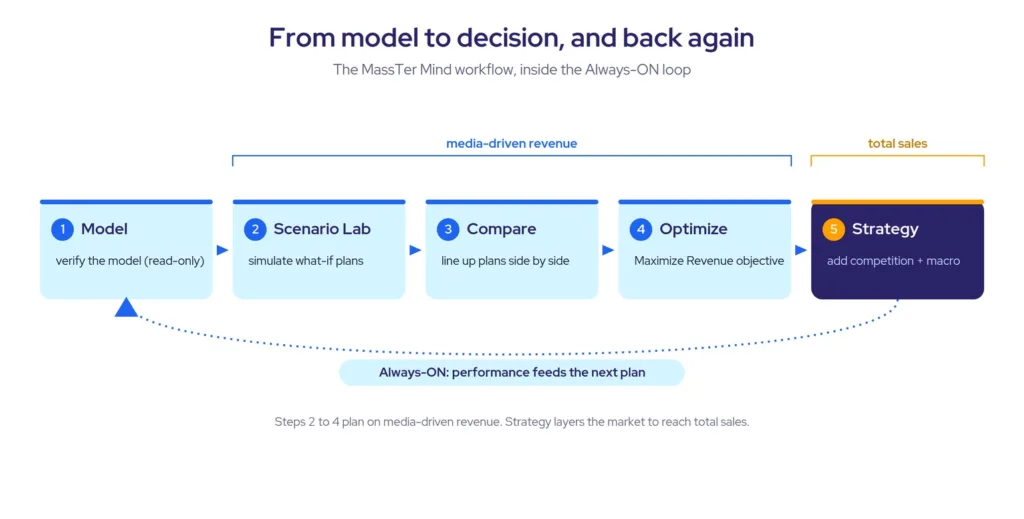
A model that can only report the past answers neither. This is the line most tools cannot cross, and it is the line that separates a measurement report from a planning engine. In fact, it is also how the software category now splits. In MassTer Mind, our no-code marketing budget optimization software, the two live side by side: the Scenario Lab for simulation, the Optimization Engine for the constrained answer.
Simulation asks what a chosen plan delivers. Optimization asks which plan delivers the most under set constraints. A model that can only report the past answers neither.
Test the plan before you commit the spend
Here is the discipline I want every planning team to adopt. Before the budget is signed, test it.
Move budget between channels and watch revenue respond. Change the timing of a flight. Turn a channel on or off for a period. Replay last year’s pattern against this year’s curves. Model a rise in media cost. Do all of it at whatever level the question sits, across every region, in a single market, or on one channel, and watch the numbers move before a dollar is committed.
Then compare. Line every plan you built next to each other, total spend and total revenue, month by month across the year. As a result, the winning plan stops being the one argued most forcefully in the room and becomes the one the data supports.
The winning plan should be a matter of data, not the loudest voice in the room.
At this stage the revenue you are testing is media-driven. That is the right scope for comparing plans against each other. It is not yet the whole picture, which is where most planning stops and where it should not.
Your plan lands in a market you do not control
Media-driven revenue tells you what your own spend can do. It says nothing about the market your spend lands in, and that usually cuts one way: a number built on calm conditions promises more than a real market, with competitors moving and the economy shifting, will hand back.
A competitor doubles their budget. The category softens in a downturn. A price war opens. None of these move because of your plan, and all of them move your result. As a result, a plan that ignores them is a plan built for a market that does not exist.
This is where the Strategy layer matters. It takes the same tested plan and adds the conditions around it: competitor activity that raises or lowers your ceiling independently of your spend, and the macroeconomic climate the year is actually run in. The output is no longer media revenue. It is total sales, what this plan delivers in this market, against these competitors.
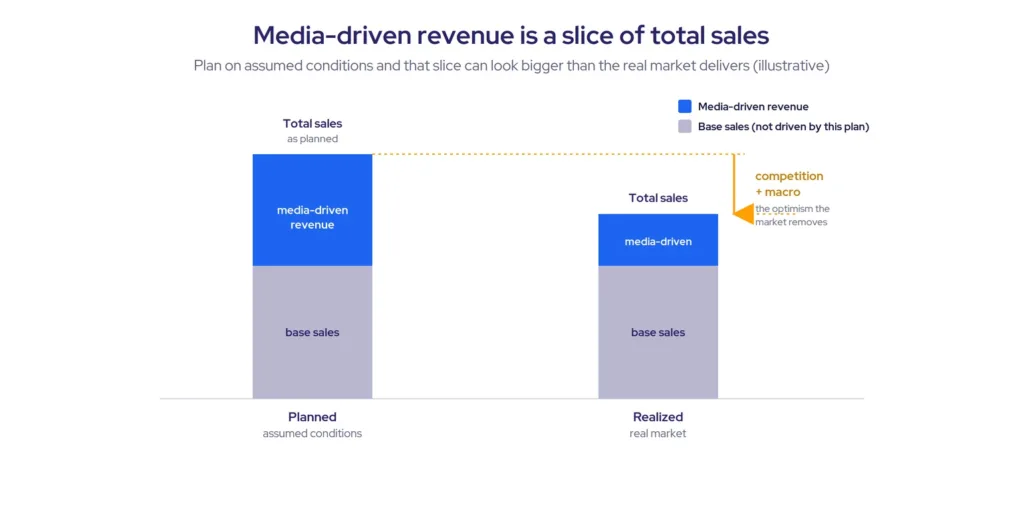
Media-driven revenue tells you what your spend can do. Total sales tells you what your spend can do while a competitor doubles theirs and the category softens.
Most planning tools never get here. Simulating total sales, not just media response, is the part of the job the market rarely covers, and it is the part a CMO is actually accountable for.
A recommendation a CFO cannot interrogate is one a CFO will overrule
I have said for years that the measurement that lands is the one a CFO can understand. The same is true of a plan.
A budget recommendation that arrives as a single number from a system nobody can question does not survive contact with finance. It gets discounted, then overruled, and the model goes back in its drawer. Every recommendation has to show its working: why this allocation, what it assumes, what it means for the business.
That is also why the tool has to be usable by the people who plan, not only the people who model. No-code access lets a marketer or a finance lead run a scenario without waiting on a data scientist. Transparency lets the analytics leader trust it and the CFO defend it. You need both. One without the other is either a black box or a toy.
A plan is a loop, not an event
The last mistake is treating planning as a once-a-year set piece. You build the plan, commit the budget, and wait twelve months to find out how wrong you were.
Markets do not wait twelve months. The plan you tested in January is running in a February that has already moved.
This is why the model has to sit inside a live loop. You build the strategy, feed it into execution, track performance as it happens, and send what you learn back into the model so the next plan is sharper than the last. Inside our Always-ON platform, MassTer Mind feeds MassTer PACE, and PACE feeds it back. That is the difference between a plan you file and a decision engine you run.
The stakes are not abstract. On a client’s first model run, MASS Analytics typically finds around 30% of the media budget sitting in the wrong place. That reallocation only becomes real when someone commits to it, and someone only commits when they have tested it and can defend it. For the mechanics of the optimization itself, we have written up how marketing mix optimization works in detail.
Where this lives: MassTer Mind
Everything I have described is the job MassTer Mind was built to do. Specifically, it is MASS Analytics’ no-code marketing budget optimization software, and it sits on top of a finished Marketing Mix Model rather than replacing it. By design, it is also model-agnostic: it works on top of any Marketing Mix Model, whatever platform built it, open source or proprietary, a commercial tool or a model your own data science team wrote. As a result, you keep the modeling approach you trust, while MassTer Mind turns its output into a live planning and budget optimization engine.
How Marketers and Finance Actually Use It
As a no-code SaaS platform, it puts the work in the hands of the people who own the budget. In practice, a marketer or a finance lead can simulate unlimited what-if scenarios, forecast marketing performance, allocate budget across channels, and run a constrained optimization against an objective such as Maximize Revenue, with no code and no wait on a data scientist. From there, the optimization engine searches thousands of budget allocations across channels, campaigns, brands and time periods, then returns the plan that best meets your objective and constraints. Meanwhile, AI Smart Insights read the model alongside it and flag where you are over-invested against saturation and where marketing ROI is being left on the table.
The real advantage is the freedom it gives you. Every lever of a media plan is at your fingertips: change the cost, the mix, the flighting, the timing, any parameter that matters, and watch revenue respond on the fly, with no rebuild and no queue. When a scenario looks right, hand it to the AI-powered optimizer to go the extra mile, then layer the external factors on top, competition and macro conditions, to read the overall sales that plan would produce. Ultimately, build any scenario you want, optimize it, then test it against the real world, all in one place.
Call it marketing budget optimization software, marketing budget allocation software, marketing optimization software, or an automated Marketing Mix Modeling platform. The label matters less than the shift it makes, from static reports to tested decisions. And because MassTer Mind runs inside the MASS Analytics Always-ON platform, that shift is continuous: each plan feeds execution, performance feeds back, and the next plan starts sharper than the last.
Frequently Asked Questions
It is software that turns a Marketing Mix Model into a planning tool. Instead of only reading past performance, it lets you test budget scenarios, run constrained optimization against an objective such as Maximize Revenue, and forecast the outcome before you commit. Good tools are a no-code SaaS platform, so a marketer or finance lead can run a plan without a data scientist. MassTer Mind is the MASS Analytics version, and works equally as marketing budget allocation software, marketing optimization software, or an automated Marketing Mix Modeling platform.
They answer opposite questions. Scenario planning, or simulation, starts with a plan you choose and returns the outcome it should produce. Optimization starts with an objective and constraints and returns the allocation that meets them best. You use simulation to test specific ideas, and optimization to find the allocation you would not have thought to try. A complete planning tool does both.
Not with a no-code planning tool. The statistical work happens once, when the Marketing Mix Model is built. After that, running a scenario is a matter of moving spend, timing and constraints and reading the result. That is deliberate: the people who own the budget, marketers and finance leaders, should be able to test a plan themselves rather than queue for analyst time.
A well-built model can, and a serious plan should. Competitor pressure and macroeconomic conditions move your results independently of your own spend, so a plan tested only on media response is incomplete. Layering these external factors on top of the plan shifts the output from media-driven revenue to total sales, the number a CMO is actually held to.
Media-driven revenue is what your spend produces in isolation, holding the outside world still. Total sales is what your spend produces in the real market, where competitors act and the economy shifts. Media-driven revenue is the right scope for comparing plans against each other. Total sales is the right scope for committing to one, because it reflects the year you will actually run.
By closing the loop. A one-off model produces a report and goes stale. An always-on model feeds each plan into execution, tracks performance as it happens, and returns what it learns so the next plan improves. The model stops being a document you consult once a year and becomes a system you plan with every cycle.
Yes. MassTer Mind is model-agnostic. It works on top of any Marketing Mix Model, whatever built it, whether an open-source library, a commercial platform, or a model your own team wrote. You do not have to rebuild or migrate your model to plan and optimize with it, which makes it a marketing budget optimization layer for the modeling approach you already trust.
The question for your next planning round
Before your next planning round, ask one question. Can you test the plan before you commit the money, or are you still finding out after the quarter closes?
If the answer is the second one, the model is not the problem. The gap between the model and the plan is.
- ✓A Marketing Mix Model only pays for itself at the moment it changes a budget decision, and that moment happens in the plan, not the report.
- ✓Simulation and optimization answer different questions, and a real planning tool has to do both, and show its working.
- ✓The scenarios that decide a year, competitor moves and macro shifts, sit outside media-driven revenue and belong in the plan as total sales.
- ✓No-code access gets the plan into the hands of the people who own the budget; transparency is what makes the recommendation survive finance.
- ✓Planning is a continuous loop, not an annual event, and the model earns its keep only when it runs inside one.
For the full workflow behind these ideas, from building the model to reading the outputs, see our Comprehensive Marketing Mix Modeling Guide.