

- →What marketing mix modeling is — and the five capabilities every MMM delivers
- →What data feeds a model — the four input categories
- →Why MMM works without cookies — and what it does not replace
- →How the MMM process works — a six-phase map
- →What your first model can realistically look like
Marketing Mix Modeling (MMM) was developed to answer those questions precisely. Not approximately. Not directionally. With a quantified evidence base that can be put in front of a CFO and defended.
I have been building and using MMM for over twenty years, across markets in Europe, North America, the Middle East, and Asia Pacific. Today, The discipline is more accessible than it has ever been, and more relevant. This article gives you the foundation you need to understand it, commission it intelligently, and know what to expect from a first model.
What marketing mix modeling is
Marketing Mix Modeling is the art and science of using advanced statistical techniques to measure the impact of marketing and non-marketing factors on sales, or any other chosen business KPI, and to use that understanding to deploy future spend where it will generate the greatest return.
That is a full definition. In practice, the simpler version is this: MMM looks at everything that happened in a market over time and disentangles which forces drove your sales. It gives each factor a number. Then it tells you where to put the next pound or dollar to make it work harder.
John Wanamaker said more than a century ago that half the money he spent on advertising was wasted, but he could not tell which half. MMM was built to answer that question.
Marketing Mix Modeling disentangles the contribution of every sales driver (media, price, promotions, seasonality, competitive activity) and assigns each a number. It tells you what worked, by how much, and where the next investment will work hardest.
The five capabilities every model delivers
Every MMM engagement delivers five core capabilities:
Disentangling sales driversImportantly, sales never move for one reason. In any given week, dozens of forces are at work simultaneously: your own media spend, your pricing and promotions, what competitors are doing, what the season demands. The model separates each one and credits it accurately.
Quantifying contributionAs a result, every driver gets a number. The business knows precisely what is generating growth and by how much — not in relative terms, but in revenue.
Measuring return on investmentRevenue generated per unit of spend, calculated across every channel. In short, this provides a rigorous basis for investment decisions, not a marketing team’s assertion.
Predicting future performanceIn addition, the model applies its estimates to planned future activity and forecasts the revenue outcome of different investment scenarios.
Optimizing the budgetMMM identifies where the next unit of spend generates the highest incremental return. It shifts investment there, increasing total revenue from the same budget — or identifying how much more budget a planned increase actually requires.
What MMM measures: the four input categories
A marketing mix model reads everything that plausibly drove your sales over a historical period. In practice, this means four categories of data:
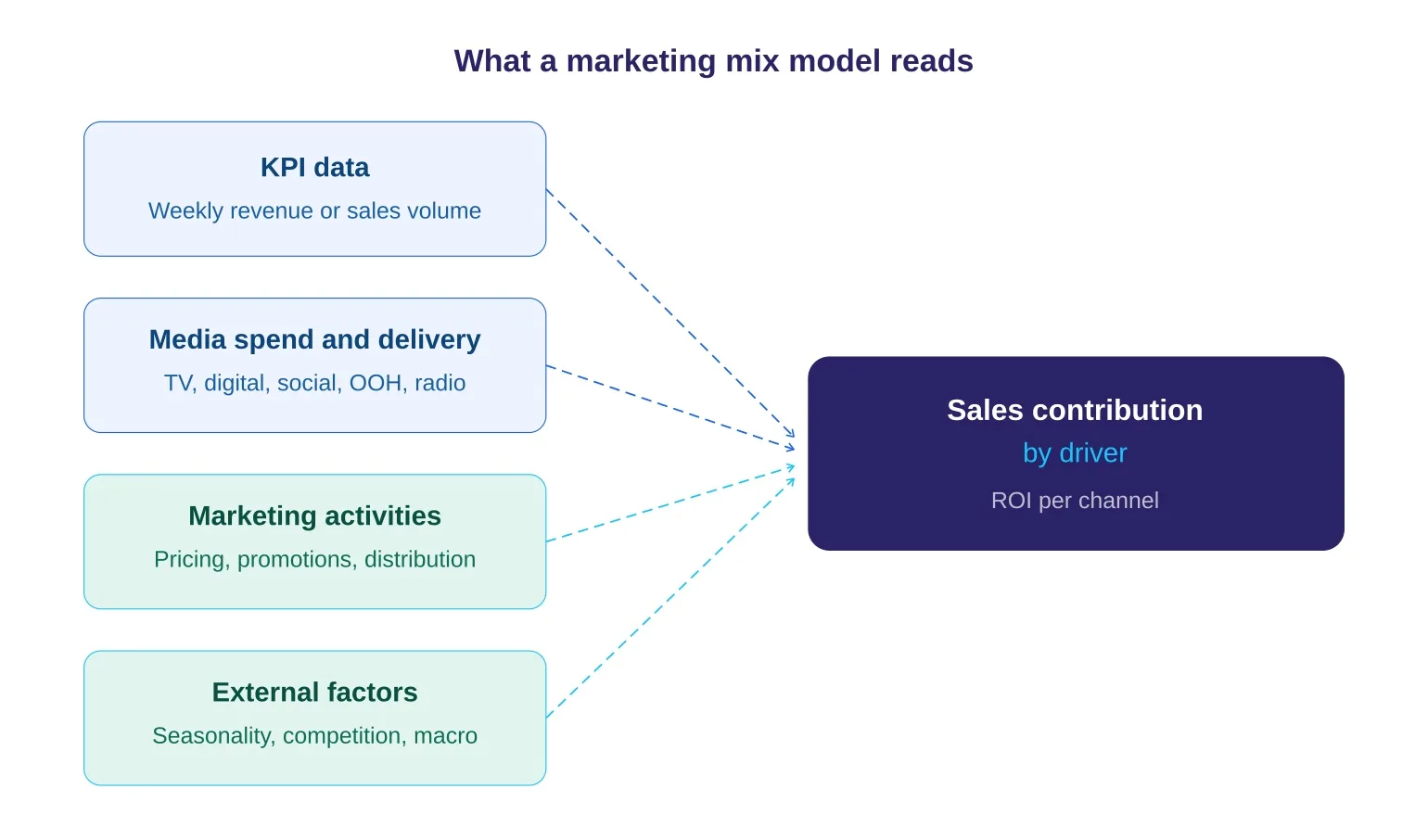
KPI dataThe business outcome being explained: typically weekly revenue, sales volume, or a brand metric like consideration. This is the dependent variable — the thing the model tries to account for.
Media spend and deliveryPaid, owned, and earned media across every active channel: television, digital display, paid search, social, out-of-home, radio, press, influencer activity. Spend is the input; delivery (impressions, GRPs, clicks) is the signal.
Marketing activities beyond paid mediaPricing, promotions, trade spend, distribution changes, product launches. These are often the most powerful drivers in the model and the most frequently omitted from a brief.
External factorsSeasonality, calendar events, competitor activity, macroeconomic context, weather where it is relevant to the category. The model must account for these or it will wrongly attribute their effects to the media variables.
The model is only as good as the data that feeds it. Before you question a result, question the inputs. Garbage in, garbage out is not a cliché in MMM. It is the most common cause of a model that fails in the debrief.
That last point matters practically. A brand that ran a major distribution expansion during the modeling period and did not include it in the brief will see its television ROI inflate by a factor of two or three, because the model has no other variable to explain the growth. For this reason, The data scoping conversation has to be exhaustive.
“MMM has never relied on cookies or individual-level tracking. Its privacy compliance is not a retrofit. It is how the method was designed.”
Worth noting, too, is what MMM does not do. It does not track individuals, provide real-time performance visibility, or replace in-platform dashboards for operational decisions. Instead, MMM sits at the strategic layer of the measurement stack, above those tools, asking a different question: across all the investments we made, what actually drove the business, and what should we do differently?
How the MMM process works: a six-phase map
MMM is not a single calculation applied once. It is a structured process that moves through six phases. Understanding each phase is what allows a marketing leader to brief an MMM engagement well, evaluate its quality, and act on its outputs with confidence.
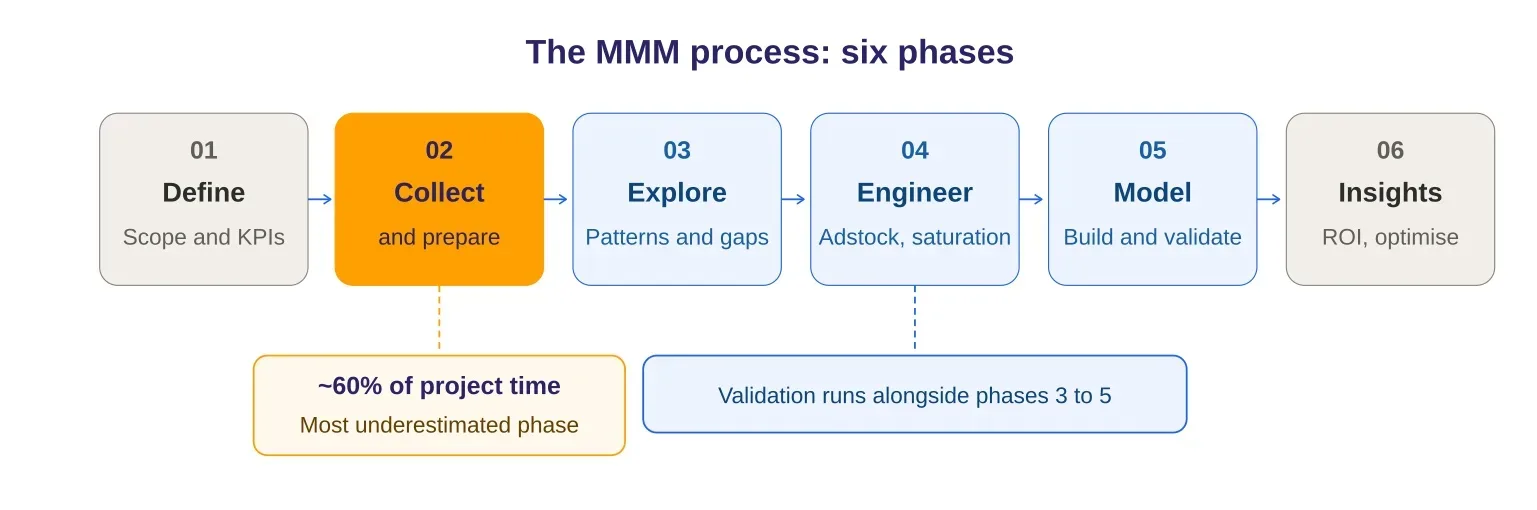
The six phases, step by step
Data preparation typically consumes around 60 percent of total MMM project time. The challenge is rarely a shortage of data. It is the heterogeneity: files in different formats, owned by different teams, at different granularities.
Source: MASS Analytics internal benchmark data
This workflow is iterative. In other words, a model is not a one-off event. The best brands run it continuously, refreshing the model as new data arrives and treating it as a live decision-support system rather than an annual strategy exercise.
What your first model can realistically look like
Admittedly, there is a version of the MMM conversation that presents the discipline as something only large brands with mature data practices can afford. That version is out of date.
For example, a first MMM can be built on three years of weekly data, a handful of media channels, and a clearly defined KPI. It does not need to split spend by region or by sales channel from the start. A national model, built at the total business level, is a legitimate and valuable starting point.
The goal of a first model is to measure contribution and return on investment at the channel level. Which channels are driving incremental revenue, and by how much? What is the ROI on the major spend lines? That understanding alone changes the quality of budget conversations. It gives the marketing team something more defensible than a plan built on gut feel and platform dashboards.
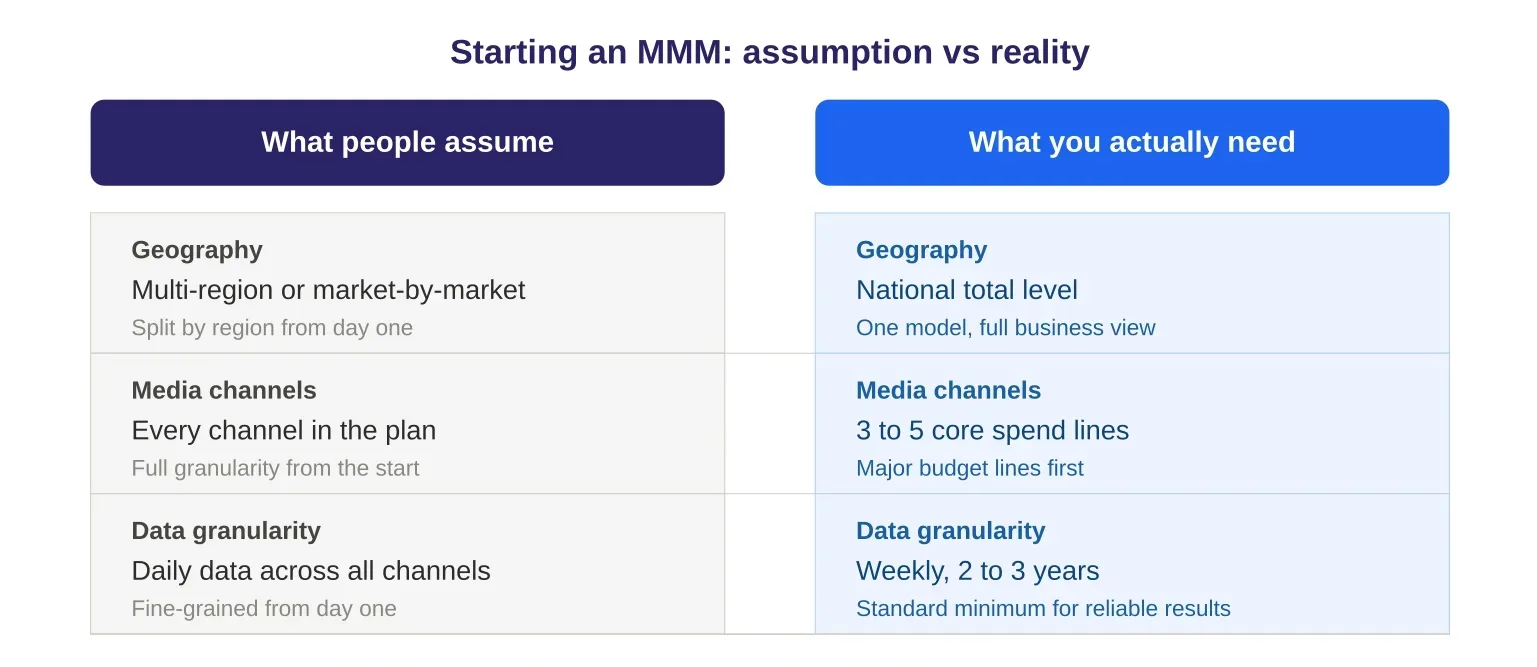
Your first MMM does not need to model everything. Measure contribution and ROI at the channel level. That alone changes the quality of your budget conversations and gives your marketing team something defensible to bring to finance.
Growing the model over time
From there, the model grows with the business questions. In the second year, add more granular media splits. In the third, introduce brand equity variables, test-and-learn calibration, or multi-region analysis. Each layer adds precision. Nevertheless, The starting point does not need to carry all of that. For a structured approach to scaling your MMM over time, see the Walk, Run, Fly framework.
Frequently asked questions
What is the difference between MMM and a platform dashboard like Google Analytics or Meta Ads Manager?
Platform dashboards report performance within their own walled garden using the platform’s own attribution logic. Meta tells you what Meta thinks Meta contributed. Google tells you what Google thinks Google contributed. Neither can see what the other is doing, and neither can see your television spend, your pricing changes, or the competitor promotion that ran in the same week.
MMM measures every channel simultaneously using independent statistical analysis. It does not ask each channel to mark its own homework. That independence is precisely what makes the ROI numbers defensible in a budget meeting. A platform will never tell you that its own channel is underperforming. MMM will.
Do I need a data science team in-house to run an MMM?
No. The skill you need internally is the ability to brief an MMM engagement well and interrogate the outputs rigorously. That is a commercial skill, not a technical one. You need to know which business questions matter, which drivers to include in the brief, and whether the results pass a logic check against what you know about the business.
However, the modeling itself can be handled by an external partner or a purpose-built MMM platform. What you cannot outsource is the business knowledge that makes a model useful. The brands that get the most from MMM are the ones where a senior marketer or analytics lead owns the outputs and challenges them.
How often should an MMM be updated?
It depends on how fast your media mix and market conditions change. The traditional approach runs an MMM study once or twice a year, which works for stable categories where the strategic questions do not change frequently. The limitation is that you are always looking at a picture that is months old by the time it reaches the debrief.
A continuous refresh model updates as new data arrives, typically weekly or monthly, giving the business a measurement layer that moves in step with decisions rather than behind them. The right cadence is the one that matches how quickly your organization can act on the outputs. A model refreshed weekly is only valuable if the business can realistically adjust spend at that frequency.
The discipline that earns its seat at the table
Marketing Mix Modeling does not produce insights that are interesting. It produces numbers that are defensible. It quantifies the contribution of each channel to the quarter’s result, expressed in revenue. The return generated per unit of spend is comparable across every channel in the plan.
Moreover, it forecasts the revenue outcome of different budget scenarios before the spend has gone out.
The CFO sitting across the table in a budget meeting does not care whether the marketing team believes television drives brand equity. They care whether the evidence is there. MMM is how the evidence gets there.
If you are new to MMM, the right question to take into your next planning cycle is not whether the discipline applies to your brand. It applies to any brand that spends money on marketing and wants to know whether that money is working. The right question is where to start. For most brands, the answer is simpler than it sounds.
Key takeaways
- ✓MMM assigns a revenue number to every sales driver simultaneously and tells you where the next investment will work hardest.
- ✓What is missing from the data brief matters more than the volume of what is present. An omitted driver silently inflates the ROI of correlated channels.
- ✓MMM works without cookies. It has always operated at the aggregate level, with no dependency on individual-level tracking.
- ✓A first model does not need to model everything. Contribution and ROI at channel level is enough to change the budget conversation.
- ✓Validation is not a quality check at the end. It runs alongside the modeling from the first iteration.
Dr. Ramla Jarrar, President & Co-Founder, MASS Analytics