
MASS Analytics explains why enterprise marketing mix modeling is no longer a one-off project or a shallow dashboard, and what it means to run it as an always-on platform.
What this article argues
- •Why buying MMM by the project is a false economy
- •The four costs the one-off project model hides from the buyer
- •How an always-on platform differs from a faster project
- •Where a no-code interface and a PaaS layer each earn their place
- •What all of this changes about how you buy MMM, not just what you buy
Every enterprise buyer is handed the same two options. Commission marketing mix modeling as a one-off project, or buy a light budget tool that promises answers in a browser. One is rigorous and slow; the other is fast and thin. Most teams pick the one that hurts least and quietly accept the trade-off.
The trade-off is the problem. It assumes those two are the only shapes measurement can take, but they are not. A platform model has formed, and it does not sit between the other two on a price line; instead, it changes what the buyer actually owns at the end.
Marketing mix modeling is no longer a choice between a one-off project and a cheap dashboard. The alternative is a platform that keeps working after the deck closes.
The market still sells you a false choice
The project model is the incumbent. You commission a study, a team of analysts builds a model over several months, and in return you receive a deck. The work is often excellent, and a well-run managed MMM consultancy reads the market well. The issue is not the people; rather, it is that the delivery is a one-off, and it stops the day it lands.
The point tool is the reaction to that. It is fast, it lives in a browser, and it hands a marketer a number without a three-month wait. The speed is real, yet what gets lost is the depth: macro factors, competitor pressure, seasonality, and the model validation that makes a number safe to move a budget on.
Buyers treat these as the whole menu. They debate rigor against speed as if one has to be sacrificed for the other. In practice, that framing is comfortable, and it is wrong.
The project model loses four things the moment the deck closes
The cost of the one-off project is easy to underestimate: it is not obvious on the invoice. Four things go missing, and none of them show up until the engagement ends.
Time goes first. Analyst hours are absorbed by data wrangling and preparing for the read, not acting on it. The cycle is spent getting ready to present.
Trust goes next. Unfamiliar methodology and black-box techniques erode boardroom confidence the moment the consultant leaves the room and cannot answer the follow-up.
Opportunity disappears too. A response curve built on last quarter’s mix cannot identify where this quarter’s marginal dollar should land. Commercial reactivity is the casualty.
Connection breaks last. When the learnings arrive after the planning round is locked, the teams who need them most disengage, and analytics drifts back into a silo.
When a model is rebuilt from scratch every cycle, the same labor reproduces the same errors on a quarterly clock.
This is the deeper issue with buying measurement as a project. Reporting and modeling that are rebuilt each cycle inherit every manual choice and every taxonomy mismatch from the last one; as a result, the same effort produces the same defects, just later. We wrote about this failure mode in more detail in why most MMM programs optimize reports, not outcomes.
The fast dashboards trade rigor for speed
The point tools solve the speed complaint, but they create a new one. To be quick and cheap, most of them narrow what they model. They lean on last-click signals or short windows, skip the macro and competitor variables, and present a clean number with none of the validation behind it.
For a directional read that is sometimes acceptable. For a budget decision at enterprise scale, however, it is not. A number a CFO can move ten million dollars on has to survive questions about seasonality, saturation, and confidence. Transparency matters here, and it is not the same thing as open code. We made that argument in full in transparency was never about the source code.
MMM is becoming a platform, not a faster project
The alternative is not a cheaper consultant or a deeper dashboard. Instead, it is marketing mix modeling software run as a platform, where data preparation, modeling, and optimization are wired into one continuous loop rather than handed off between a vendor and a slide.
The four components of the loop
In our platform that loop has four named components. MassTer Flow prepares and ingests data on cloud-native pipelines. From there, MassTer Studio builds and validates the models without code. Next, MassTer Mind turns the outputs into scenarios and optimized budgets. Finally, MassTer PACE runs live execution on the cloud, keeping the models refreshed and the next decision ready. Together, one system covers four jobs, with no handoff gap.
Built to fit both the boardroom and the data team
The interface matters as much as the engine, and MassTer Mind is where that shows. A finance or marketing leader gets it as a no-code SaaS interface to run what-if questions in the same session they are asked. Meanwhile, an enterprise analytics team gets the same MassTer Mind decision engine as a platform and API layer, plugged into their own data pipelines on Snowflake or BigQuery. In other words, the SaaS surface and the PaaS layer are not two products; they are the same capability, exposed at the level each user needs.
MassTer Mind is also a white-box. A CFO can run a zero-code what-if in the morning, while the data science team keeps full sight of the model priors, decay, and saturation parameters the answer rests on. After all, transparency here is not open source; it is being able to see and defend every assumption behind the number.
And the decision layer is model-agnostic. MassTer Mind can optimize on a model built in MassTer Studio, or on one you bring from an open-source library such as Google Meridian or Meta Robyn, or from an in-house Python or R script. It does not force you to abandon a model you already trust. We get into where that interoperability helps, and where it does not, in MassTer PACE versus open-source MMM.
A platform is not a faster project. It is data preparation, modeling, and optimization wired into one continuous loop.
At a glance: the three models compared
Set side by side, the three categories are easy to tell apart.
| Criterion | The one-off project | The point tool | The always-on platform |
|---|---|---|---|
| Cadence | Quarterly or annual project | Continuous but shallow | Continuous and full depth |
| Rigor | High, but frozen at delivery | Low, correlation-led | High and re-validated each refresh |
| Access when it ends | Ends when the deck closes | Locked inside a black box | A running system you own the outputs of |
| Who can use it | Analysts and the delivery team | Marketers only | No-code UI for business, API layer for data teams |
| Best when | You need a one-off deep read | You need a fast directional signal | You need measurement wired into planning |
Verdict: choose a one-off project for a single deep read, the point tool for a quick directional signal, and a platform when you need measurement wired into how you actually plan.
Always-on is a structural change, not a scheduling change
The word that gets misused here is always-on. It does not mean a dashboard that refreshes more often; rather, it means the continuous operation of three coupled processes: calibration as new data arrives, ongoing model health checks, and automated forecasting against the current state of the world.
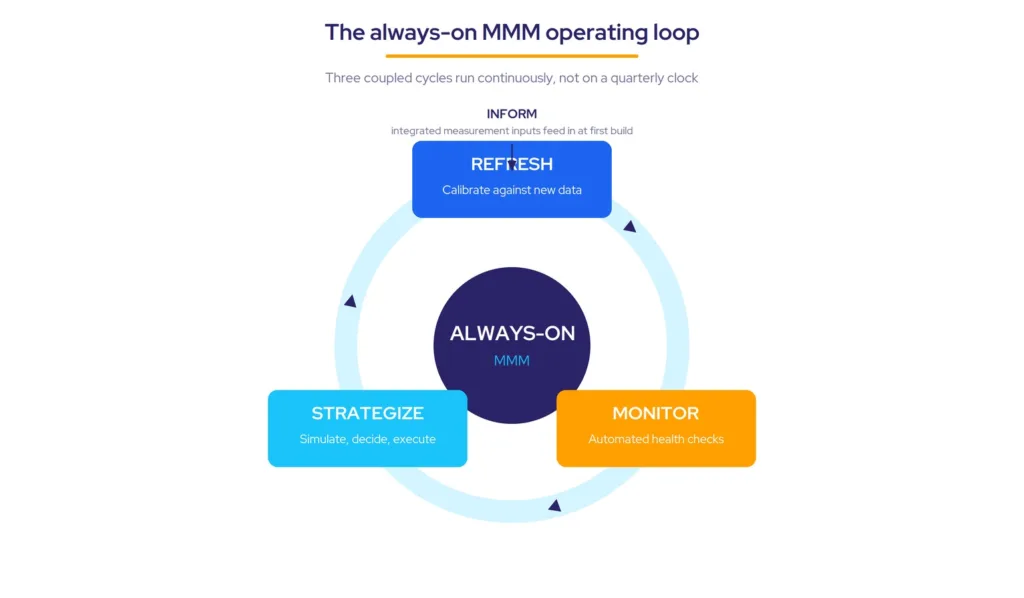
The three coupled processes
Continuous calibration comes first. The model is re-estimated as new spend and sales flow in, on the same cadence the business plans on, not on a fixed annual clock. The read you act on this month was calibrated against the data that closed this month.
Health checks run alongside it. A model refreshed but no longer fitting its data is producing the wrong answer faster. Automated diagnostics watch residual structure, stability, and saturation, and flag a rebuild before a bad model informs a plan.
Forecasting happens on demand. Once the model is calibrated and validated, simulations run whenever needed. A CMO asking what happens if the team shifts two million dollars from paid social to connected TV next month gets an answer in the same session, not the next quarter.
Always-on MMM is not a dashboard refreshed more often. It couples calibration, validation, and forecasting into one system that runs on the planning calendar.
A response curve built on last quarter’s mix cannot tell you where this quarter’s marginal dollar should land.
What always-on delivers in practice
The payoff is measurable. Brands that adopt a two-tier cadence, quarterly rescoring for tactical calls and annual full rebuilds for strategy, have reached around 89 percent revenue forecast accuracy across multiple planning cycles in our benchmark. For example, one international airline we worked with used continuous optimization to lift marketing ROI by 17 percent while cutting total media spend by 15 percent. That is not a better slide; it is a shorter distance between a market event and the budget response.
This changes how you buy, not just what you buy
If measurement is a running system rather than a delivered document, procurement changes with it. The question stops being how good is the deck and becomes what do we still have in ninety days. A capability you keep is a different purchase from an opinion you rent. That said, this does not mean giving up the expert partnership: a managed service delivered on the platform keeps the expertise and the continuity together, instead of trading one for the other.
Two practical points follow. First, this is the real substance of the build-versus-buy debate: not whether to own MMM, but whether the thing you buy keeps compounding after go-live. We walk through that decision in build versus buy MMM. Second, enterprise software has to clear enterprise procurement. That means certified security and a buying path that fits how large organizations actually purchase, which is why our security posture and marketplace availability sit alongside the methodology, not behind it. Our security and compliance position is part of the product, not an afterthought to it.
None of this displaces the discipline. The modeling still has to be rigorous, the validation still has to hold, and the numbers still have to be defensible. If you want the methodology foundation underneath all of this, our Comprehensive MMM Guide is the place to start. Still, the platform model does not lower the bar on rigor; it refuses to let rigor expire when the deck closes.
Frequently asked questions
Questions about the always-on model
Always-on MMM is the continuous operation of three linked processes: recalibrating the model as new data arrives, running automated health checks on its fit, and generating forecasts and scenarios on demand. It is a different operating model from a periodic study, not a faster version of one.
A one-off project delivers a study and a deck at a point in time, and the capability leaves when the engagement ends. A platform is a running system you keep, where data preparation, modeling, and optimization stay wired together and refresh on your planning cadence rather than resetting each cycle. A managed service can run on top of the platform, so you keep the expert partnership without the one-off expiry.
Yes. Modern MMM runs as cloud-native software with a no-code interface for marketers and finance teams, and a platform and API layer for data teams to connect it to their own pipelines. The SaaS surface and the PaaS layer expose the same modeling engine at the level each user needs.
Questions about buying and running it
A dashboard surfaces historical outputs in a friendlier form. MMM software builds, validates, and re-estimates the model itself, then turns it into optimized budget decisions. A dashboard shows you what happened. A modeling platform tells you where the next dollar should go and how confident that answer is.
No, it structures it. The common pattern is two-tier: lightweight rescoring against new data for tactical decisions between builds, and a full rebuild on a longer cycle to capture structural change. Always-on couples the two so the model stays both current and valid rather than drifting between annual studies.
Yes. Enterprise buyers increasingly procure MMM software and managed services through cloud marketplaces, which lets them buy through an existing cloud account with vetted vendor security and negotiated pricing. It is a procurement path that fits how large organizations already purchase software.
The question for your next budget round
The false choice has cost the industry a decade of measurement that expired on delivery. The platform model exists to end that. So, before your next planning round, ask the simple question: when the deck closes, does your measurement keep working, or does it wait for you to commission it again?
For the broader picture of how AI factors into that always-on shift, see AI marketing mix modeling.
If your measurement partner disappears when the deck closes, you did not buy a capability. You rented an opinion.
Key takeaways
- •The project-versus-dashboard choice is false, and it has quietly capped what most teams get from measurement.
- •Buying MMM by the project loses time, trust, opportunity, and connection the moment the deck closes.
- •Running MMM as a platform wires data preparation, modeling, and optimization into one continuous loop.
- •Always-on is a structural change, not a faster schedule: calibration, validation, and forecasting run as one system.
- •Buying a running capability rather than a delivered document changes procurement, including security certification and marketplace availability.