

MASS Analytics argues that open code is not an open model. Dr. Ramla Jarrar on the Meridian and Robyn debate, and why transparency in MMM lives in the baseline, not the license.
- →The real question behind AdExchanger’s “Trojan horse” reporting on Google Meridian and Meta Robyn
- →Why open code and an open model are two different things
- →The transparency test that lives in the baseline, not the license
- →What default settings decide for you, and who benefits from where everybody starts
- →The case for specialist MMM software, argued on baseline decomposition, speed, granularity, and encoded experience
An Equation That Doesn’t Hold
Transparency is not a license type. It is the ability to interrogate every number your model produces, trace it back to an assumption, and change that assumption when your business says otherwise. Open-sourcing a codebase does not deliver that on its own. This week, the industry started saying so out loud.
On July 14, AdExchanger published a piece by James Hercher with a title I wish I had written: “Google’s Meridian and Meta’s Robyn: A Gift to Measurement or Trojan Horses?” The reporting is worth your time. According to the agency executives and measurement vendors Hercher spoke with, Google has tied sales KPIs to Meridian adoption, Meta appears to be quietly winding Robyn down, and a number of measurement providers have built their “proprietary” offerings on Meridian source code without their clients realizing it.
I run a specialist MMM software company, so you should read what follows knowing where I sit. But my argument is not that open-source MMM is bad. Meridian, Robyn, and PyMC-Marketing brought Bayesian methods into the standard toolkit of our industry, and they legitimized MMM for thousands of teams who would never have commissioned a study. That is a real contribution.
My argument is narrower and, I think, more uncomfortable. The industry has quietly accepted an equation that does not hold: open source equals transparent, commercial equals black box. Neither half survives contact with practice.
Open Code Is Not an Open Model
Google’s own framing is instructive. Harikesh Nair, Google’s senior director of data science, told AdExchanger that open-sourcing Meridian is “crucial for building trust” because marketers and data scientists can “look under the hood to verify the model’s methodology for themselves.”
That is true, as far as it goes. It just does not go very far.
What a marketer needs to interrogate is not the library. It is the model built with the library. The priors someone chose. The adstock and saturation transformations someone applied. The way the baseline was specified. The calibration decisions that pushed a coefficient up or down. None of that is visible in a GitHub repository, because none of it lives there. It lives in the implementation, and the implementation is only as transparent as the team and the tooling behind it.
Nobody defends a media budget with source code. Budgets are defended with a decomposition the CFO can interrogate line by line.
A data analyst quoted in the AdExchanger piece said MMM let their team swap a microscope for a telescope and feel more control over campaign reporting. Hercher’s next line is the one that matters: that transparency and control “can be an illusion.” The code being readable tells you the methodology is sound. It tells you nothing about whether the model in front of you reflects your business or somebody’s defaults.
The Transparency Test Lives in the Baseline
If you want to know how transparent an MMM setup really is, do not ask for the repository. Ask for the baseline decomposition.
The baseline is everything your model attributes to non-media drivers: pricing, distribution, seasonality, brand strength, competitive pressure. In most off-the-shelf implementations, it is reported as one flat number. Sales you would have made anyway. A single gray block at the bottom of the waterfall chart.
That single block is where businesses hide from themselves. We worked with a retailer whose media reporting looked healthy while the business softened underneath. Decomposing the baseline showed a 60% erosion in base demand that the media-focused view had missed entirely. The full story is in our published case study. No conversation about media ROI mattered until that erosion was on the table.
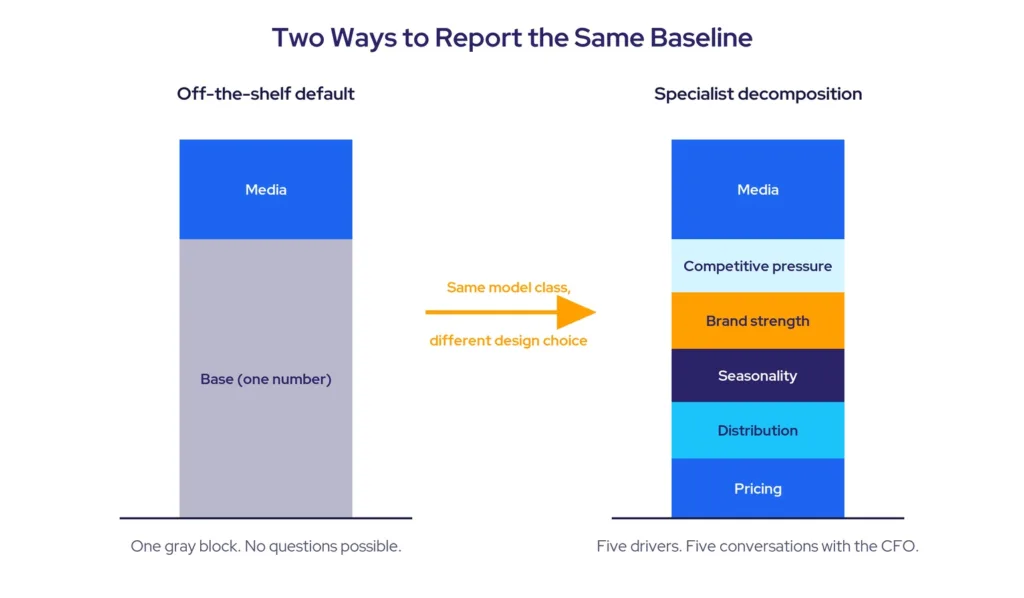
A model that reports the baseline as one flat number is transparent in code and opaque in business.
This is a design choice, not a limitation of statistics. Specialist platforms decompose the base because the modelers who built them spent years being asked “so what is driving the decline?” by CFOs. General-purpose libraries leave the baseline lumped because decomposing it requires vertical knowledge the library cannot ship. Both choices are rational. Only one of them is transparent in the sense that should matter to you.
Defaults Are a Decision Someone Else Made
The sharpest quote in the AdExchanger piece comes from one of the measurement executives interviewed: “There’s a huge amount of power in setting where everybody starts in a solution.” The same executive observes that too many advertisers run Meridian on off-the-shelf specs, and that the tool is free “in the sense that a puppy might be free, not like a free beer.”
Sit with that for a moment. A default adstock setting is a claim about how your advertising decays. A default saturation curve is a claim about where your next dollar stops working. A default prior is a claim about what the answer should look like before your data arrives. Most users never see these as choices, because defaults do not announce themselves.
One size fits all is the opposite of transparency. It is standardization wearing transparency’s clothes.
A default adstock setting is a claim about your business that someone else made. Most users never see it as a choice.
Specialist software earns its keep by departing from defaults deliberately. Retail is not insurance. CPG is not entertainment. A grocery model needs promo mechanics and store-level granularity. A financial services model needs regulatory constraints and long purchase cycles. When a platform is built for verticals, those departures are encoded, visible, and adjustable. When a platform is built for everyone, the defaults are doing the deciding, and you inherit whatever assumptions serve the default-setter.
Speed and Granularity Are Operational Transparency
Transparency is not only about seeing the assumptions. It is about being able to test them. And testing has a price: every question you ask of a model costs a rebuild.
When a rebuild takes six weeks, the price of a question is six weeks. Nobody pays it, so the first defensible model becomes the final model, unchallenged. When a rebuild takes hours, questions become affordable: what happens to the recommendation if the adstock is wrong, if the base is decomposed differently, if last summer’s anomaly is treated as an outlier. That is sensitivity testing, and it is the difference between a model you could interrogate in theory and one your team interrogates every month. A model nobody can afford to question is not transparent in any way that matters, whatever the license says.
When a model rebuild takes weeks, nobody tests assumptions. When it takes hours, sensitivity testing becomes routine.
The same goes for planning granularity. A model that reports “Google” as one channel cannot inform a planner who allocates across YouTube, Search, PMax, and Demand Gen separately. Another practitioner quoted in the AdExchanger piece made exactly this point, and he is right. Recommendations that arrive above the granularity you plan at are not insights. They are decoration.
And a model without commercial sense embedded, without spend constraints, halo effects, cannibalization, and productive spend ranges built into the optimization, produces recommendations your media team will quietly ignore. An ignored model is the least transparent model of all, because nobody is looking at it.
Experience Encoded Beats Code Exposed
Here is the part I can only say in the first person. Our platform exists because our team built hundreds of models across retail, CPG, financial services, telecom, and entertainment before we wrote a line of product code. Every validation check, every vertical template, every guardrail in the software is a mistake we made once, on a real engagement, and made sure we could not make again.
That is what specialist software is: judgment, productized. Open-source libraries encode excellent statistics. They cannot encode your category’s commercial logic, because no general-purpose library can. The experience either lives in your team, at whatever depth your team happens to have, or it comes encoded in the solution.
For teams that want that encoded experience with full visibility, this is exactly what we built MassTer Studio to do: every transformation, prior, and baseline component exposed and editable, with the vertical knowledge already in the room. The same logic runs continuously in MassTer PACE for teams whose planning cadence cannot wait for a quarterly refresh. We have also published a direct comparison with open-source MMM for readers weighing the two paths in practice.
One more line from the AdExchanger piece deserves the last word of this section. The lesson Hercher draws is that measurement is most trustworthy when it is not provided by the players who stand to benefit from the results. Independent specialists have exactly one incentive: to be right. Our models carry no media business to protect. That independence is not a marketing line. It is the reason the specialist category exists.
“Transparency is not a license type. It is the ability to interrogate every number your model produces and change the assumption behind it.”
The Question to Take Into Your Next Budget Meeting
The Meridian and Robyn debate has been framed as open source versus commercial. That framing suits the platforms fine, because it keeps the conversation on license types instead of on the assumptions inside the models.
Ask a different question. Whoever runs your MMM, in-house team, agency, platform, or vendor, ask them to show you two things: the baseline decomposition, and the list of default settings they changed for your business, with the reason for each change.
If the answer is a clear walk-through, you have transparency, whatever the license says. If the answer is silence, it does not matter that the code is on GitHub. And if you want the methodology foundation behind every question in this article, start with our Comprehensive MMM Guide.
Frequently Asked Questions
-
Is open-source MMM more transparent than specialist MMM software?
Not by default. Open source makes the methodology auditable, but transparency for decision-makers lives in the implementation: the priors, transformations, baseline specification, and calibration choices. A specialist platform that exposes and explains every assumption can be more interrogable than an open-source model run on defaults.
-
What did AdExchanger report about Google Meridian and Meta Robyn?
The July 2026 piece by James Hercher reported that Google ties sales KPIs to Meridian adoption while Meta appears to be winding Robyn down, and that several measurement vendors have built proprietary offerings on Meridian code. It questions whether platform-provided MMM tools serve marketers or the platforms themselves.
-
What should transparency mean in marketing mix modeling?
Transparency means every number the model produces can be traced to an assumption, and every assumption can be inspected, challenged, and changed. That covers the baseline decomposition, media transformations, priors, and optimization constraints. Readable source code is one ingredient, and on its own it is not sufficient.
-
Why does baseline decomposition matter in MMM?
The baseline typically carries the majority of sales, and a single flat base number can hide structural problems. In one of our published retail cases, decomposing the base revealed a 60% erosion in base demand that media-focused reporting had missed. Decision-grade MMM separates pricing, distribution, seasonality, and brand effects.
-
Are Meridian’s default settings a problem?
Defaults are a starting point, and Meridian’s are competently chosen. The problem is that many advertisers never move off them. One measurement executive told AdExchanger that Meridian provides a good baseline but should be customized for every business, and that there is enormous power in setting where everybody starts.
-
Does specialist MMM software offer more flexibility than open-source libraries?
For most teams, yes in practice. Open-source code is infinitely flexible for those with the engineering capacity to modify it. Specialist platforms make flexibility usable: vertical-specific structures, fast model rebuilds for sensitivity testing, granular planning outputs, and commercial constraints in the optimizer, all without a rebuild project.
- ✓Transparency in MMM is the ability to interrogate and change a model’s assumptions. It is not a property of the license the code ships under.
- ✓AdExchanger’s July 2026 reporting shows platform incentives shaping the open-source MMM wave: sales KPIs tied to Meridian adoption, Robyn quietly wound down, and vendors reselling Meridian under proprietary labels.
- ✓The baseline decomposition is the sharpest transparency test. A flat base number once hid a 60% erosion in base demand from a retailer we worked with.
- ✓Default settings are decisions someone else made for your business. Specialist software makes those decisions visible, vertical-specific, and changeable.
- ✓Measurement is most trustworthy when the measurer does not benefit from the result. That applies to platforms, and it is the reason independent specialists exist.