
A de-identified MASS Analytics case study on moving Marketing Mix Modeling in-house across 10 markets and four brands. Here is where the savings came from.
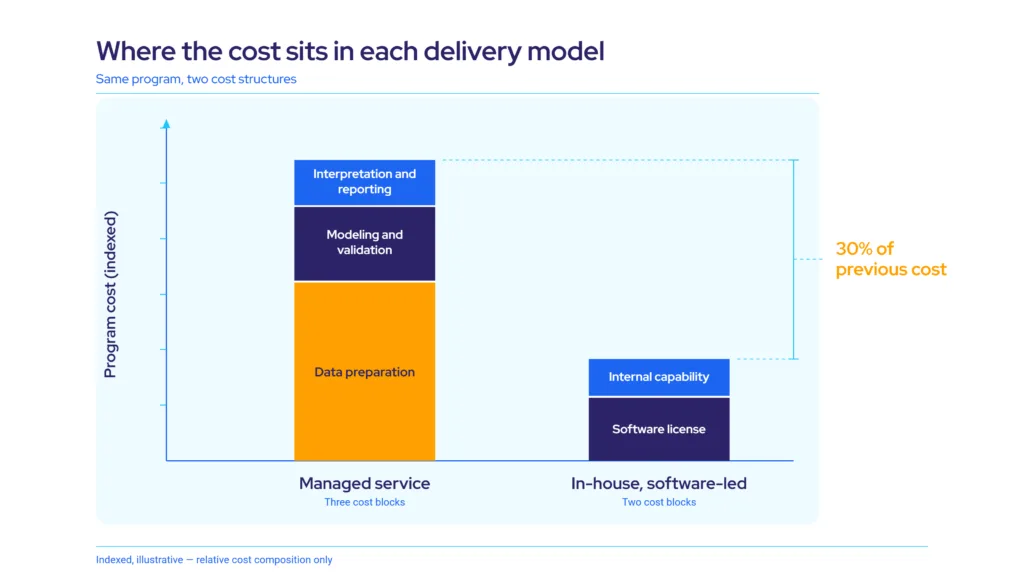
- ✓A global CPG leader moved its MMM program from managed service to in-house capability across 10 markets, 15 product groups and four brands. The in-house model cost 30% of the managed service, releasing 70% of the budget.
- ✓The saving was not a discount. It came from moving repeatable work out of billable hours and judgment work inside the organization.
- ✓Around 60% of a typical MMM project’s time goes on data preparation. Automating it removes the largest cost line without affecting model quality.
- ✓By Year 3 the team ran the program unaided, with a Center of Excellence scaling consistent analysis across brands and markets.
Most organizations reviewing an MMM contract ask whether the modeling is good. Fewer ask what proportion of the fee is buying modeling at all.
This case study answers that question for one organization, by showing the arithmetic rather than asserting it.
CASE STUDY · GLOBAL CPG · DE-IDENTIFIED
The starting position
A global CPG leader was running Marketing Mix Modeling across 10 markets, 15 product groups and four brands, with full omnichannel scope. MASS Analytics delivered the program as a traditional managed service.
The models were sound. The operating model around them was the problem.
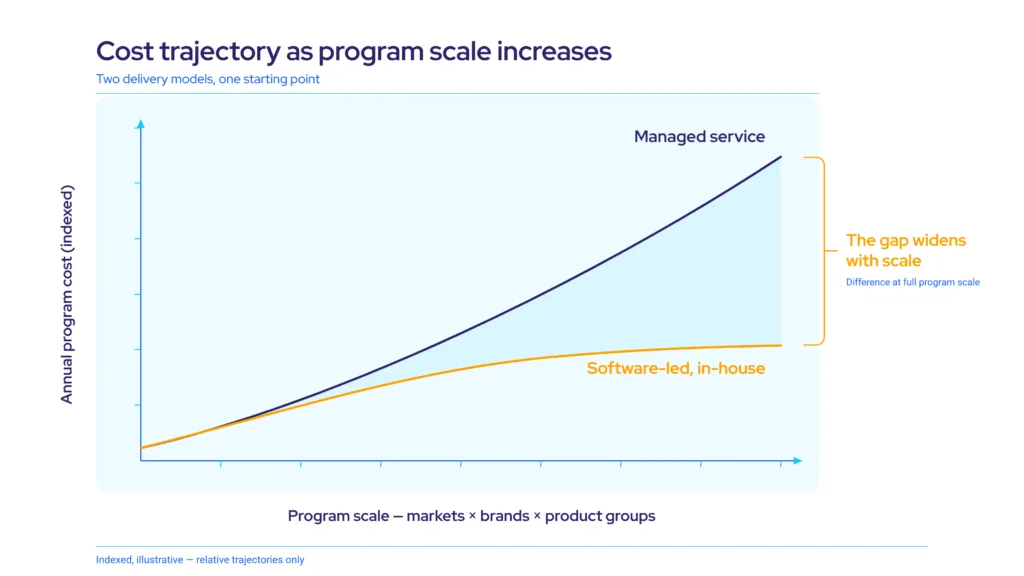
At that scale, the managed service had become expensive and difficult to extend. Ten markets, 15 product groups and four brands is 600 model-unit combinations before a single refresh cycle even begins. A managed service, meanwhile, prices in recurring human effort. Because of that, every additional market, brand or refresh added billable hours. As a result, the cost curve rose faster than the value did.
Leadership set four objectives before committing to the change:
- Prove the economic case for in-housing against the managed service.
- Build analytical maturity internally.
- Take full ownership of model design, execution and transparency.
- Establish a centralized Center of Excellence able to scale MMM consistently across markets and brands.
“The models were sound. The operating model around them was the problem.”
Where the savings came from
The in-house solution required 30% of the cost of the previous managed-service model. That released 70% of the budget for reinvestment into priority marketing initiatives and internal resourcing.
That figure is only useful if the mechanism behind it transfers, so it is worth taking apart.
Step one: most of the billable hours were not judgment
Around 60% of a typical MMM project’s time goes on data preparation. That means reconciling sources, resolving date overlaps and handling missing values. It also means standardizing formats across products and regions, and managing multiple separate files that arrive on different cadences.
That work is repetitive and follows fixed rules. It is also the single most expensive thing to buy by the hour. That is because it recurs every cycle and scales with the number of units being measured.
Step two: automate the repeatable work
MassTer Flow handled the preparation. It standardizes multiple source formats into a single structure, and resolves overlaps and missing values. It also runs pipelines that keep the data current, rather than requiring it to be re-cleaned each cycle.
The effect on model quality is neutral to positive, because automated preparation also removes a class of error that is difficult to detect by inspection. For example, a silent mis-join across regions does not announce itself in the output.
“The largest cost line in most MMM programs is not the modeling. It is preparing the data to be modeled.”
Step three: move the judgment work inside
What remains after automation is the part that genuinely needs people. That includes specification decisions, validation, interpretation, and the argument with a stakeholder who does not believe a coefficient.
That work moved inside the organization instead of disappearing. This is the part most in-housing business cases get wrong. They treat capability transfer as a training line item, rather than as the mechanism that makes the saving durable.
How the transition was sequenced
The move ran on the Walk, Run, Fly framework, which exists because in-housing fails when teams attempt it as a single handover event.
Walk: build and enable
MASS Analytics delivered the initial models, automated the data preparation, and provided platform access from day one. It also engaged marketing and commercial stakeholders early, through business-focused storytelling rather than methodology walkthroughs.
That early engagement is doing more work than it appears to. Aligning stakeholders on the questions the model should answer, before it produces answers, is what matters most. It determines whether teams use the outputs, or work around them.
Run: co-creation and capability development
Model development has become a shared process across analytics, marketing and finance. MASS Analytics guided the methodological decisions, while also helping the team synthesize insights, refine business questions, and establish consistent ways of working.
Continuous training ran alongside, and full data ownership transferred during this phase rather than at the end. The team operated on its own data, in its own environment, with support still available.
Fly: full autonomy
The organization became self-sufficient in running MMM end to end. Marketing teams used the insights to guide planning, optimize investment and drive cross-functional alignment. Simulations and scenario analysis became embedded in decision cycles, and MASS Analytics provided light-touch advisory wherever teams wanted it.
The distinction that matters commercially is this: the internal team was now able to drive adoption and scale the capability across the business. That is a different competence from running a model.
From delivered models to owned capability
Three stages of transfer
01
Walk
MASS Analytics builds the models, automates data preparation, provides platform access.
What transfers:
The models.
02
Run
Model development co-created across analytics, marketing and finance. Data ownership transfers.
What transfers:
The method.
03
Fly
The organization runs the program end to end. Light-touch advisory only.
What transfers:
Ownership of adoption.
Increasing internal ownership
Illustrative — stages are sequential, pace varies by organization
Governance and adoption
Cost savings do not survive an adoption failure. If teams do not trust the outputs, they rebuild or re-outsource the program within two cycles, and the saving reverses.
Clear KPI mapping and structured frameworks aligned leadership and functional teams. These made the MMM outputs interpretable without a methodology briefing. MASS Analytics also walked stakeholders through scenario simulations against real commercial questions, and coached teams on integrating the insights into planning and investment cycles.
As a result, teams embedded MMM in day-to-day decision-making, instead of consulting it periodically.
What it delivered
Three outcomes, in the order they arrived.
- Cost: A flexible, software-led model replaced high recurring service fees, producing significant year-on-year efficiencies rather than a one-off saving. The in-house program ran at 30% of the previous cost and released 70% of the budget for reinvestment.
- Capability. By Year 3 the team operated independently, with MMM embedded in planning and optimization. A Center of Excellence supported multiple brands and markets through consistent, automated analysis.
- Speed and transparency. Insight delivery accelerated. Transparency also improved across teams, because the assumptions were now visible to the people relying on them. Delivering a path to 70% savings gave the measurement function clear evidence of its own value to the wider business. That is not a trivial outcome for a team that has to defend its budget.
For wider context on what the measurement itself recovers, alongside what the operating model saves, consider two figures. MASS Analytics uncovers an average of 30% misallocation on a client’s first model run. Clients running continuously, meanwhile, make 80% of their reallocations on current-month MMM, not on a model built the previous quarter.
“Not a discount. A different distribution of who does the repeatable work.”
What an agent changes from here
MASS Analytics delivered this program with software and expert support, rather than with an AI agent. The sequence is worth being precise about, because it shows where the ceiling was.
Automation removed the data preparation cost. It did not remove the cost of operating the loop. Someone still had to decide when to refresh, read the output and build the scenarios. They then had to take the recommendation into the planning meeting. That work stayed human because it needed people applying judgment continuously, rather than once.
An agent that operates the loop end to end is what moves that line. Maia, the MASS Analytics Marketing Mix Modeling Intelligence Agent, runs the refresh, reads the results, constructs the scenarios and recalibrates as evidence accumulates. It then hands judgment back to the team at the points where judgment is needed. Every model it builds carries the same validation, versioning and explainability checks as a hand-built one. Each also comes with an audit trail of what it did and why.
The economics in this case study establish what removing repeatable work is worth. An agent simply extends the same logic further up the stack.
Walk, Run, Fly is not the only shape in-housing takes. A separate CPG program, roughly ten times the regional scale, took a nested-modeling route instead — see how a multinational CPG brand scaled MMM across 250 regions.
Frequently asked questions about in-housing MMM
Cost and savings
In one global CPG program spanning 10 markets, 15 product groups and four brands, the in-house operating model cost 30% of the previous managed service. That released 70% of the budget for reinvestment. The saving comes from two changes rather than from negotiation. Automating data preparation removes the largest recurring cost line, because roughly 60% of a typical MMM project’s time goes on preparing data rather than modeling it. Moving the remaining judgment work inside the organization then converts a recurring fee into internal capability that compounds. The ratio will differ by program scale. The more markets, brands and refresh cycles a program covers, the larger the gap. That is because managed-service cost scales with the number of units measured, while software cost does not.
Data preparation. A typical Marketing Mix Modeling project spends around 60% of its time reconciling sources and resolving date overlaps. It spends the rest handling missing values and standardizing formats across products and regions. This work recurs every cycle and scales with the number of units being measured. That makes it the most expensive component to buy by the hour, and the first thing to automate. Automating it also removes a class of silent error, such as a mis-join across regions, that is difficult to detect by inspecting the output.
Process and timeline
Walk, Run, Fly is the MASS Analytics framework for moving Marketing Mix Modeling from an external service to an internal capability in three stages. During Walk, MASS Analytics builds the initial models, automates the data preparation and provides platform access. MASS Analytics engages stakeholders early on the business questions the model should answer. Run turns model development into a shared process across analytics, marketing and finance. Continuous training runs throughout, and full data ownership transfers during the phase rather than at the end. By Fly, the organization runs the program end to end, with light-touch advisory available. The framework exists because in-housing fails when teams attempt it as a single handover event.
In this program the team was operating independently by Year 3, with a Center of Excellence scaling consistent analysis across multiple brands and markets. The timeline depends less on the modeling than on the organizational work. That means aligning stakeholders on the questions the model answers, building internal confidence in interpretation, and establishing governance that survives staff turnover. Cost savings begin earlier than full autonomy, however, because the largest saving comes from automating data preparation, which happens in the first stage.
Quality and governance
An MMM Center of Excellence is a central internal team that owns modeling standards, methodology and quality control. It supports multiple brands and markets with consistent analysis, rather than each unit commissioning its own work. It is the structure that makes in-housing scale: without it, in-housing tends to produce several incompatible local models and a governance problem. In this program the Center of Excellence was one of four objectives set before the transition began. The others were proving the economic case, building analytical maturity and taking full ownership of model design and execution.
It does not have to, and in this program the in-house capability matched, and in several areas exceeded, the previous managed-service setup. Quality depends on three things surviving the transition. These are the modeling method, the validation standards applied to every run, and the judgment of the people specifying the models. The first two transfer with the software and the documented process. The third is what capability transfer is for, which is why a structured pathway matters more than a handover document. In-housing risk is rarely the mathematics — it is attempting the transfer in one step.