
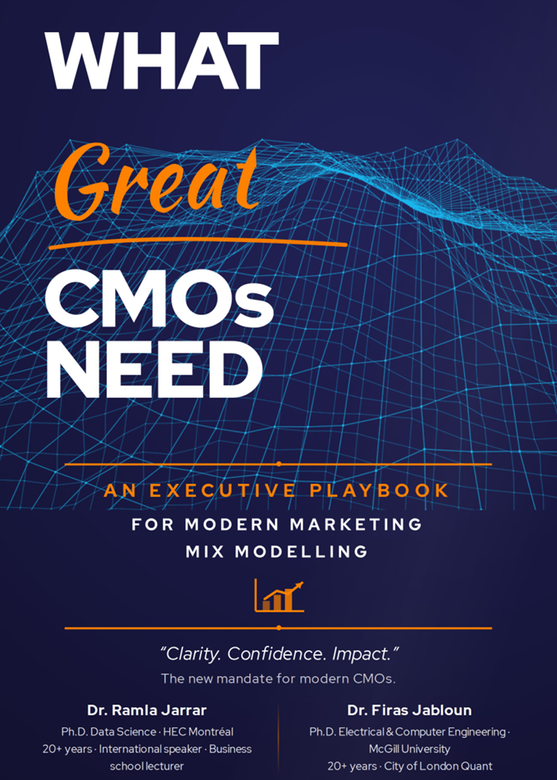
What Great
CMOs Need
Every budget cycle ends the same way: prove which half worked. Attribution cannot see television, it cannot see brand, and it cannot see the base, which is usually 50 to 70% of your sales. This is the handbook for measurement that holds up when the CFO starts asking.
From the authors of the Comprehensive Marketing Mix Modeling Guide · Chapter 1 free to read · Hardback posted worldwide, no charge
Twenty years of models,
written down
Neither author set out to write a book. It came out of two decades of building Marketing Mix Models for businesses with real money on the line: global retailers, airlines, banks, CPG brands, media agencies, across Europe, North America, the Middle East and Asia Pacific.
What became obvious was that the same questions came up in every boardroom, whatever the category and whatever the market. Which half worked. Where the next pound should go. What happens if we cut. And the same misunderstandings came up too, usually expensive ones.
This book is that accumulated experience, set down in the order a marketing leader actually needs it.
Five parts, built the way a marketing leader actually meets the problem
Most MMM writing explains the mathematics. This book explains the logic: what the model is doing, why it matters commercially, and where the limits of its confidence sit. A result you understand is a result you can defend.
- 01Why measurement is now your problem
- 02What MMM answers, and doesn’t
- 03MMM, attribution and experimentation
- 04Build, buy or blend
- 05What you need before you start
- 06How MMM works
- 07Contribution and ROI
- 08Diminishing returns and brand
- 09Is this model any good?
- 10Optimisation
- 11Scenario planning
- 12Reporting to the board
- 13Driving adoption
- 14Always-ON and integrated measurement
- 15AI in MMM

Dr Ramla Jarrar
Twenty years of building Marketing Mix Models for global retailers, airlines, banks and CPG brands across Europe, North America, the Middle East and Asia Pacific. Co-author of the Comprehensive Marketing Mix Modeling Guide and the academic work underlying MassTer.

Dr Firas Jabloun
Lead architect of the econometric and machine learning frameworks that power MassTer. His work spans model design, validation methodology and the translation of statistical evidence into commercial decisions for senior marketing leaders at scale.
Read the first chapter free
No form, no download. The first chapter is here on the page. Read it, judge it, and if it earns its place, tell us where to send the rest.
Why measurement is now your problem
Marketing spend is now defended in the same terms as every other line on the budget: money in, revenue out, with the working visible.
Every marketing leader meets the same moment eventually. A channel the numbers say to cut, and a strong suspicion that the numbers are wrong. How that moment goes, whether you hold the line or lose the budget, comes down to one thing: the quality of the evidence behind the decision, and whether you can put it in front of the people questioning you.
For most of the last century that evidence did not exist in any rigorous form. Marketers knew that some of what they spent was working. They could not say how much, or which part. The discipline that closed the gap is Marketing Mix Modeling, and it has become the measurement standard for leaders who have to defend every dollar of investment they hold. It has also, quietly, become part of the job. The question is no longer whether marketing will be held to a revenue standard. It is whether you will arrive at that conversation with the evidence or without it.
What has changed is not that marketing became measurable. It is that the rest of the business stopped accepting that it was not. Finance now expects the marketing line to be justified the way every other investment is justified, in revenue produced against money spent. Boards ask where growth came from, and they expect an answer that survives scrutiny. The money itself is under pressure: marketing budgets have settled at 7.7 per cent of company revenue, down from more than 11 per cent in the years before the pandemic, and half of CMOs now work with 6 per cent or less (Gartner, 2025). The channels have multiplied, the spend has grown, and the tolerance for “we think it is working” has fallen close to nothing. That combination is why a discipline that once sat quietly with a specialist team is now something the person accountable for the budget has to understand well enough to interrogate. You do not need to build the model. You do need to be able to tell a sound one from an unsound one, and to defend what it tells you when the room pushes back.
What Marketing Mix Modeling actually does
Marketing Mix Modeling, or MMM, uses statistical analysis of your own historical data to separate the contribution of every factor that moves sales: media, price, promotions, competitor activity, seasonality, and everything else happening in the market at the same time. It tells you what worked, by how much, and where the next dollar will work hardest. The KPI does not have to be sales. It can be revenue, volume, sign-ups, policies written, or any other outcome the business runs on, and the method is the same; what changes is only the number the model is asked to explain. That is the whole of it, and everything technical in the reference edition exists to make that one sentence trustworthy.
Underneath the term sit five capabilities, and it is worth being precise about them, because each one answers a different question you will be asked in a budget review. The model separates the drivers of sales, so that each channel is credited with the effect it actually produced rather than the effect it happened to sit alongside. It quantifies the contribution of each of those drivers, attaching a number to every one so the business knows what is generating growth and by how much. It measures return, calculating the revenue produced per unit of spend across every channel, which gives you a defensible basis for where money goes rather than an argument about who shouted loudest. It forecasts, applying those measured effects to a planned activity so you can see the revenue outcome of a scenario before you commit to it. And it optimises, identifying where the next dollar earns the highest incremental return and moving investment there, so the same budget produces more revenue.
Read those five again as questions. What is working. By how much. What is the return. What happens if we do this instead. Where should the next dollar go. Those are the questions a marketing leader is now expected to answer with a number and a method, and they are the questions MMM was built to settle.
The five build on one another in a particular order, and the order is where the value comes from. Measurement comes first and produces the evidence base: what each driver did. Forecasting turns that evidence forward: what a driver will do under a plan you are considering. Optimisation acts on the forecast: where to move money so the plan produces the most growth. Run only the first and you have a report on the past. Run all three and you have a planning capability, which is a different thing entirely, and the thing this book assumes you are trying to build.
Sales never move for one reason
In any given week, dozens of forces push demand up or down at once. Your own media spend. Your pricing and your promotions. What competitors are doing on both. The weather. Whether the product is on shelf. The time of year. The state of the wider economy. Sales are the combined result of all of them, and they arrive as a single number that hides its own composition. The temptation is to explain a good week by the thing you did most recently. The model exists precisely to resist that temptation.
Its job is to read each weekly movement in the sales line and assign it to the right cause, so that each driver is credited with what it earned and nothing more. Figure 1.1 sets out the eight groups of factors that appear in almost every commercial MMM, from media and price through promotion, distribution, competitor activity, seasonality and the wider economy. When you look at a contribution chart later in this book, this is what you are looking at: that single weekly sales figure, decomposed into the forces that produced it.
- Search, social, video, display
- Retail media
- TV, radio, print
- Out-of-home, cinema
- RRP and shelf price
- Price vs. competitors
- Pack-size and value tier
- Cross-price effects
- Discounts and price cuts
- Multibuys and bundles
- Coupons and loyalty offers
- Trade and retailer promotions
- New product launches
- Reformulations, relaunches
- Pack design and labelling
- Range extensions and cuts
- Numeric and weighted distribution
- Shelf share
- On-shelf availability
- E-commerce coverage and stock
- Competitor media spend
- Competitor pricing changes
- Competitor promotions
- Competitor launches
- Yearly seasons and weather
- Holidays and bank holidays
- School terms and paydays
- Day-of-week effects
- Macroeconomy and GDP
- Consumer confidence
- Exchange rates, inflation
- Weather and category shocks
Those eight groups are worth holding in mind, because they are the vocabulary of almost every result you will be shown. There is your own media, across every channel you run. There is price, both your own and the gap to competitors. There is promotion, the temporary mechanics that pull demand forward in time. There is distribution, the plain question of whether the product is available to buy. There is competitor activity, which moves your sales while you do nothing at all. There is seasonality, the predictable annual rhythm of the category. There is the wider economy, the conditions no brand controls. And there is the base. A good model accounts for all eight. A model that leaves groups out does not make their effects vanish; it silently reassigns them to whatever it did measure, which is how a channel ends up blamed or credited for something it never did.
One of those groups deserves attention now, because it is the one most often missing from the budget conversation. It is the base: the level of demand your business earns with no current media running at all, produced by accumulated brand equity, distribution presence, and the simple fact that people already know you. The base typically accounts for 50 to 70 per cent of total sales. It is the single largest signal in the data, and none of the platform tools on your dashboard can see it, because it is not generated by a click or an impression. A measurement that has no view of the base has no view of most of your business, and will systematically over-credit whatever activity happened to run while that base was quietly doing its work.
This is not a technical nicety. The base is where the return on years of brand-building actually shows up, and it explains why a brand can cut media for a quarter and see sales hold, then cut for a year and watch them erode. If your measurement cannot size the base, it cannot tell you how quickly that erosion is running, and you will learn the answer only once it is expensive to reverse. Sizing the base is one of the first things a competent model does, and one of the first things you should ask to see when a result is put in front of you.
Why the tools already on your dashboard cannot do this
Platform attribution reports what happened on the platforms that can track it. Inside that boundary it is genuinely useful, and this book does not argue otherwise. The problem is the boundary. Attribution does not see television, outdoor, radio or print. It does not capture the long-term effect of brand-building, which keeps producing sales for weeks or months after a campaign has ended. It does not account for a competitor cutting price, or a change in your own distribution. And, as above, it has no mechanism to see the base that makes up the majority of your revenue.
For a brand that invests across the full media mix, those gaps are not rounding errors. They are the difference between a channel that looks weak because its effect is untracked and a channel that is genuinely underperforming. Cutting the first is an expensive mistake, and it is a mistake made with confidence, because the dashboard looked precise. MMM exists to tell the two apart. It can, because it works backwards from your actual sales rather than forwards from what any single platform is able to observe about itself.
There is a second, subtler cost. Because attribution reports quickly and in fine detail, it feels more trustworthy than a model that reports quarterly and in ranges. Precision and accuracy are not the same thing. A figure can be exact to the decimal place and still be crediting paid search with a sale that television created three weeks earlier. The most confident-looking number in the room is often the one measuring the smallest and most tracked slice of what happened, and confidence in the wrong number does more damage than honest uncertainty about the right one.
“Precision and accuracy are not the same thing.”
What Great CMOs Need, Chapter 1Art and science, and what that means for the number you are handed
You will hear MMM described as art and science. The distinction sounds like a slogan until someone brings you a result, at which point it becomes the most practical thing in the discipline.
The science is the econometrics: the regression, the diagnostics, the validation. A measured effect is either statistically sound or it is not, and there are established tests for which. The science provides the structure and the honesty. The art is the judgement that surrounds it and makes it commercially usable. Knowing which factors belong in the model and which do not. Recognising when a statistically significant result is commercially implausible and should be challenged rather than reported. Understanding how a promotion in one month reshapes demand in the next. A model can be technically correct and still commercially wrong, and the gap between those two states is where most bad decisions are made. Part of your job is to ask the commercial question when the team has answered only the statistical one. Much of this book is about how to ask it well.
A model might report that a small, cheap channel returns far more per dollar than any other line in the plan. The statistics can be entirely sound. The commercial reading is that the channel is small precisely because it saturates quickly, and that pouring budget into it would collapse the very return that made it look attractive in the first place. The number was right. The decision it implied was wrong. Catching that gap is judgement rather than arithmetic, and it is the kind of judgement an analyst and an accountable leader are meant to supply together, each covering what the other cannot see.
Measurement is a strategic instrument, not a report
The most common way to waste an MMM is to treat it as an evaluation that arrives at the end. The strategy is set, the money is spent, and some months later a model reports on what happened. By the time it lands, the next budget has already been signed. A technically excellent model delivered into that rhythm creates almost no value, because it never touches a decision that is still open.
The alternative is to position measurement as part of the strategy itself. An MMM is most powerful when it mirrors the way your organisation already thinks: answering the questions your strategy asks, measuring the drivers your strategy intends to activate, and producing outputs that feed straight into the next planning cycle. The first build lays the foundation. After that, each cycle’s decisions on channel mix, budget and timing are informed by the previous cycle’s evidence, and strategy and measurement become a single loop rather than two stages that never quite meet. This is not a question of which model to build. It is a question of where the model sits in the organisation, and that placement is a decision only you can make.
Three strategic questions are worth naming here, because MMM is unusually good at them and they are the ones most likely to arrive on your desk.
The first is the balance between brand-building and short-term performance. Performance channels such as paid search and promotional mechanics produce an immediate, visible response inside the campaign window. Brand channels such as television, outdoor and sponsorship produce a slower effect that carries over long after the spend has stopped. The two run on different clocks, and the interaction between them is routinely misread by tools that can only see the fast half. A model that captures both gives you a direct view of how they work together, and a defence for the brand investment that short-term dashboards will always make look inefficient.
The second is performance across markets. A single media plan applied uniformly across countries assumes that what works in one market works in all of them. That assumption is usually wrong, and it is expensive wherever it is wrong. The model is what tests it, showing where channel effectiveness genuinely differs by market and where budget should move as a result. For a business running the same plan across ten countries, that one insight can be worth more than any campaign-level optimisation, because it corrects an assumption baked into the whole plan rather than tuning a single line inside it.
The third is decision-making under uncertainty. The consequential calls are rarely made in calm conditions. Budgets are set in downturns, channels are judged on incomplete data, and plans are committed months ahead of the conditions they will actually run in. The value of MMM in those moments is that it draws on what the business has already lived through: prior shocks, prior recoveries, prior demand under pressure, all of it already sitting in the data. It lets you act on evidence at exactly the point where instinct is otherwise the only thing on offer.
The mechanism is straightforward to state. A brand that has traded through a previous downturn holds, inside its own history, a record of how each channel behaved when demand fell and how quickly it recovered when conditions turned. A model reads that record and turns it into guidance for the next shock, so the response is drawn from evidence the business already paid for rather than from the loudest opinion in the room. This is where measurement earns its keep, because it is precisely when conditions are hardest that the cost of a wrong call is highest.
The organisations that get the most from measurement share three habits, and none of them is technical. They build the model to mirror their own strategic framework, so its outputs speak the language of the planning conversation rather than the language of statistics. They connect those outputs directly into the planning cycle, so each round of decisions is informed by the last round’s evidence. And they treat forecasting and optimisation as forward-planning instruments rather than reports to be filed. Where those three habits are present, the model compounds in value every cycle. Where they are absent, even a strong model decays into a slide that nobody acts on.
What changes when you own the evidence
Set the mechanics aside for a moment and consider the position. A marketing team that can prove which channels grow revenue, which are approaching the point where more spend stops paying back, and where the next dollar should go, sits in a fundamentally different place from one that cannot. That is the real shift MMM produces. Marketing stops being a cost centre with uncertain returns and becomes a revenue driver with a quantified evidence base behind every number it puts forward.
The commercial record supports the claim. Across documented engagements, brands that adopt MMM as a standing planning capability, rather than as an occasional study, achieve double-digit gains in return and pull meaningful incremental revenue out of the same budget. The gain does not come from spending more. It comes from knowing which of your existing spend is over-invested past its saturation point and which still has room to grow, and moving money from the first to the second. That is the same logic whether conditions are favourable or hostile: in growth it compounds an advantage, and under pressure it protects the investment that instinct would cut first. When a downturn forces the budget question, the leader with a model can defend the brand line and reallocate the rest to where return holds up, while the leader without one cuts across the board and hopes.
The other change is one of tempo. The traditional model ran once or twice a year, and its results landed months after the decisions they were meant to inform. That lag made measurement a diagnostic rather than a tool. As the measurement cycle has shortened to match the planning cycle, the discipline has changed character. Evidence that keeps pace with the calendar is not a report on last year; it is a live input to this quarter. A brand able to re-plan on current evidence while its competitors wait for an annual study holds a real advantage, and one that widens the longer it runs.
None of this is automatic. An MMM embedded in your quarterly rhythm, with outputs expressed in the language your leadership already uses, becomes the engine of a strategy that sharpens with every cycle. The same model, run once a year and left in a slide deck after the budget is signed, does very little. Which of those two you end up with is not a modelling decision. It is a decision about how you position the capability and what you demand of it, and it is yours to make. The rest of this book is written to help you make it well, and to give you the questions that expose the difference before it costs you a budget.
What to ask your team
- When we say a channel worked, are we measuring its contribution to revenue, or only the activity we can most easily see?
- How much of our sales is base demand we would earn with no media at all, and do we actually know that number?
- Are both short-term performance and long-term brand represented in how we measure success, or only the half that reports quickly?
- Does our measurement mirror our strategy, or are the model’s defaults quietly setting our priorities for us?
- If the CFO asked for the return on our largest line tomorrow, could we answer in revenue terms, with the working visible?
- Is our measurement wired into the planning cycle, or does it arrive after the budget has already been signed?
The book, in the post
Chapter 1 is already free to read, so you can judge the book before you ask for it. If it earns its place, tell us where to send the rest: we will post the hardback anywhere in the world at no charge.
What Great CMOs Need
- Hardback, 180 pages, 15 chapters
- Free postage, anywhere in the world
- Posted within 20 working days of confirming your address
- First run of 500 copies
Be in the room
We run exclusive breakfast sessions for CMOs and heads of measurement in key cities. One morning, the model, the evidence and the questions that do not get asked in conference keynotes.
Tell us where to send it
We do not ask for your postal address in the form. Once your request is in, we will email you to confirm where to send the book, so you can give us an office address, a home, or wherever suits.
Request your copy
The questions you are probably having
Is it really free?
Yes. The book, the printing and the postage. Nothing to pay and nothing to return, anywhere we can reliably post to.
Who gets a copy?
Anyone carrying marketing, measurement or budget responsibility. The first run is 500 copies. If we cannot post one immediately we will tell you, rather than leave you waiting.
Why do you not ask for my address?
Because most people would rather not type one into a web form. Ask for the book here, and we will email you to confirm where to send it. Your address is used to post the book, never sold and never shared. Our privacy policy sets out the detail.