

A perspective from MASS Analytics on what AI actually changes about marketing mix modeling, and why the answer is a question about ownership rather than speed.
- ✓The significant change AI brings to marketing mix modeling is not speed. It is that the model no longer has to live inside a vendor’s platform in order to run.
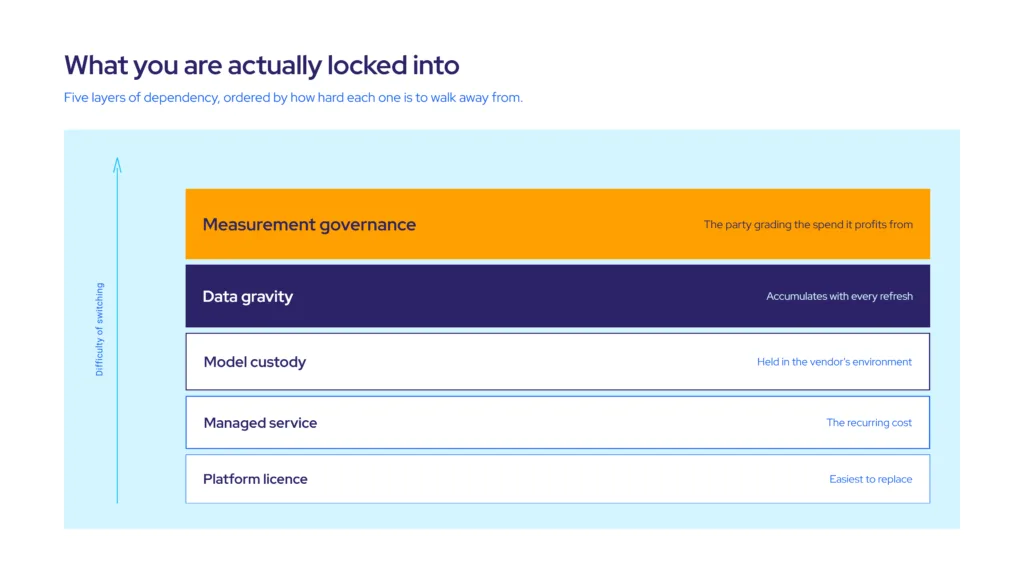
- ✓Lock-in in MMM was never only the software. It is a bundle of platform, managed service, model custody, data gravity and, in some arrangements, a partner grading the media spend it profits from.
- ✓Open source removed the license cost and published the method. It did not remove the service dependency, and it does not supply rigor, governance, or support.
- ✓One global CPG program moved MMM in-house across 10 markets and four brands at 30% of its previous managed-service cost, releasing 70% of the budget for reinvestment.
Most discussion of AI in marketing mix modeling is about speed. Faster refreshes, automated data preparation, conversational scenario planning. Work that used to take weeks now runs continuously.
The more consequential change is about ownership.
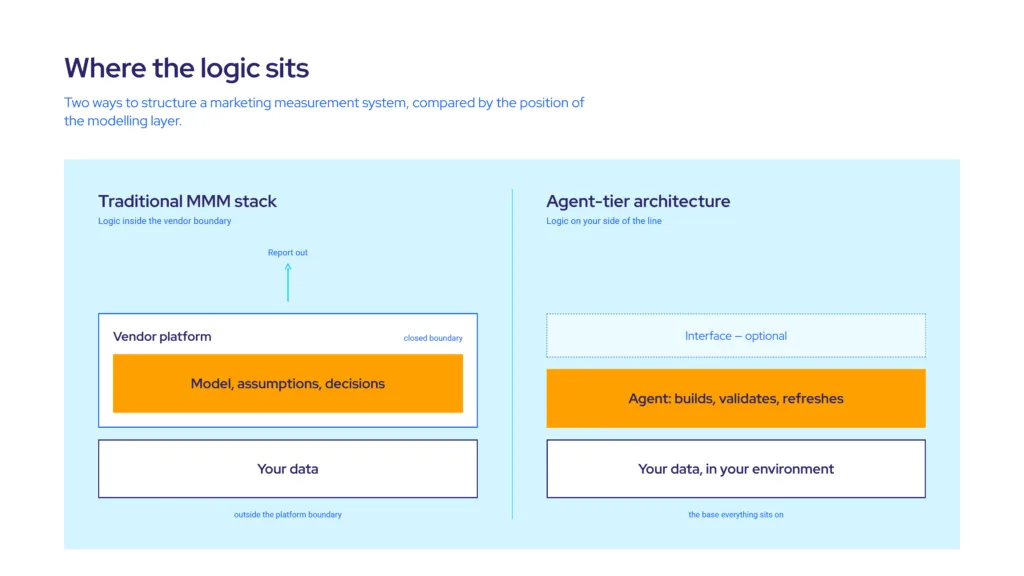
When an agent can build, validate and refresh a model against data in your own cloud environment, the model stops needing to live inside a vendor’s platform to be usable. That is the shift Satya Nadella described on the BG2 podcast in 2024: business applications are largely databases wrapped in business logic, and the logic is moving to the agent tier above them.
The software does not disappear. The value leaves the interface.
“Everyone is asking what AI does for your marketing mix model. The better question is what it does to who owns it.”
What is AI actually changing about marketing mix modeling?
AI is changing two things, and the second matters more than the first. It compresses the modeling work. And it removes the technical reason the model had to be held somewhere proprietary.
Marketing Mix Modeling (MMM) is the clearest case of this in enterprise software, because MMM is close to a pure example of what Nadella was describing. A vendor’s platform, sitting on your data, with the business logic held inside it: the model, the assumptions, the decisions. You supply spend and sales. You receive a report.
In many deployments you cannot see how the model was built, cannot change it, and cannot take it with you.
“For a category whose entire job is trust, that is a strange place to have ended up.”
What does MMM lock-in actually consist of?
Lock-in in MMM has five components, and only the first is software. This is uncomfortable for parts of the measurement industry, including the part MASS Analytics operates in.
- The platform license itself.
- The managed service wrapped around it.
- The model held in the vendor’s environment rather than yours.
- The data gravity that accumulates on their side of the boundary with every refresh.
- And, in some arrangements, a partner who benefits from your media spend also owning the measurement that grades it.
The last of those was always a governance problem, not a technology one. What changes now is that it no longer has a technical excuse.
This is why exporting model coefficients rarely resolves anything in practice. Coefficients are the smallest component of the bundle. The dependency lives in the other four.
Does open-source MMM solve it?
Open source solved part of the problem, and it deserves credit for the part it solved. Google’s Meridian and the PyMC ecosystem removed the license dependency and published the method. Anyone can read the model specification.
But it addresses two components of five.
“Open source hands you an engine and a manual. It does not hand you rigor, governance, or support.”
It does nothing about the service dependency. Teams that adopt open-source MMM without in-house capability typically replace a software dependency with a consultancy dependency, which is the same lock-in under a different contract. The model still ends up being built by someone else, refreshed on someone else’s schedule, and defended by someone else in front of the CFO.
The point was never open versus closed. It is that the model, the data and the decision should belong to you, wherever they run.
What open source actually changes
Two of six dependencies move when the license opens. The other four stay exactly where they were.
What separates an agent that queries a model from one that builds it?
Custody. An agent that queries a finished model gives you answers about someone else’s artifact. An agent that builds, validates and refreshes the model gives you the artifact.
The distinction matters because vendors are blurring it. Marketing now advertises support for the Model Context Protocol, the open standard Anthropic originally built for connecting agents to tools and data, widely across the MMM category. It has become close to table stakes. What varies enormously is what sits underneath it. Some implementations expose a model that has already been fitted, so an agent can interrogate it and run scenarios. That is genuinely useful, and it is not the same thing as owning the model. The modeling decisions, the assumptions and the refresh cycle all remain with whoever built it.
“Query access to someone else’s model is not the same as custody of your own.”
The practical test is simple. If the agent were switched off tomorrow, would you still hold a model another team could run? Or only a record of the answers someone else’s model gave you?
How does Maia build and refresh models on your own data?
Maia, the MASS Analytics Marketing Mix Modeling Intelligence Agent, builds and refreshes models on your data, in the environment where that data already lives, rather than pulling it into ours. It operates the whole loop: it measures, explains what moved, builds optimized scenarios, pushes approved plans to the buying platforms, and recalibrates as evidence accumulates.
It does the work rather than narrating it. Every model it builds passes the same validation, versioning, and explainability checks as one built by hand, and the audit trail records what it did and why. Your team sets the guardrails: approval thresholds, protected budgets, activation scopes. Maia recommends and you decide how much it executes.
On the transparency property specifically: Maia includes read access to every model, coefficient, and transformation from the start, so no tier of the system hides its assumptions.
Why the architecture matters more than the claim
“Runs on your data” is easy to say and harder to demonstrate. The demonstration is architectural.
MassTer PACE, the platform Maia operates, runs as a Snowflake Native App. The full modeling lifecycle executes inside the customer’s own Snowflake account: data ingestion, model refresh, and publishing results for planning. Nothing has to be copied out to be modeled. Maia also operates across Databricks and Google Cloud environments, and connects to the enterprise AI tools a team already uses rather than requiring a separate interface.
What sits underneath the loop
Four components sit underneath the loop, and each hands off to the next. Data preparation runs continuously in MassTer Flow. From there, MassTer Studio builds and validates the models, while MassTer PACE keeps them refreshing on schedule. Outputs become comparable budget scenarios inside MassTer Mind, and the MMM Academy moves the underlying capability into the client’s own team. Maia coordinates all of it, and the audit trail records what it did at each step.
The reason this is worth spelling out is that data residency is where most measurement lock-in actually forms. A platform that requires your data to move into it accumulates switching cost with every refresh, whatever its contract says about ownership.
The part that matters most for the argument in this article is the part that is commercially awkward to offer. Maia works across modeling engines: it builds in MassTer, or in Google’s Meridian if that is where you already are. A measurement partner that will only build inside its own proprietary framework has an interest in the framework, not in the answer.
That is what makes the independence claim testable rather than rhetorical. It is also why the open-source concession above is not a hedge. Supporting an open framework is only valuable if someone brings the rigor, the validation standards and the governance to it — which is the work, and the reason the engine and the manual were never sufficient on their own.
Three degrees of custody
The same agent story, told three ways. The difference only shows when the agent goes away.
What unbundling the managed service is worth
The argument has a price attached, and it is larger than most organizations assume.
A global CPG leader was running MMM across 10 markets, 15 product groups and four brands as a managed service. Moving the capability in-house, using MASS Analytics software and the Walk, Run, Fly pathway, brought the program in at 30% of the previous cost and released 70% of the budget for reinvestment. By Year 3 the team ran it unaided, through a Center of Excellence scaling consistent analysis across brands and markets.
The mechanism matters more than the number. A managed service prices in recurring human effort, and around 60% of a typical MMM project’s time goes on data preparation rather than modeling. Automating that removes the largest cost line without touching model quality. What remains is judgment work, and capability transfer moves that inside rather than eliminating it.
Not a discount. A different distribution of who does the repeatable work.
“The largest cost line in most MMM programs is not the modeling. It is preparing the data to be modeled.”
The full breakdown, including how the transition was sequenced and where the ceiling was, is set out in the companion case study on MMM in-housing.
What the agent changes
Software and expert support delivered that program rather than an agent, and the sequence shows where the limit sat. Automation removed the data preparation cost. It did not remove the cost of operating the loop: someone still had to decide when to refresh, read the output, build the scenarios and take the recommendation to the planning meeting.
An agent that operates the loop end to end is what moves that line. The in-housing case establishes what removing repeatable work is worth. The agent extends the same logic further up the stack.
How do you test whether you own your marketing mix model?
Three questions settle it, and none of them is about the software license.
First, could you take the model artifact with you, in a form another team could actually run, if the contract ended tomorrow? Second, does the data the model runs on stay in an environment you control? Third, does the party producing the recommendation have any commercial interest in what the recommendation says?
If the answer to any of the three is no, the measurement is rented rather than owned. That holds whatever the license says, and whatever the AI layer on top of it is called.
Two predictions, one shift
In 2000, Steve Ballmer built an entire keynote around a single word: developers. The clip became a punchline.
The prediction was correct. Whoever owns the people who build things owns what gets built next, and AI has widened that group enormously. The people who now configure, extend and interrogate systems vastly outnumber the people writing the code underneath them.
Put the two Microsoft predictions together and the shift is clear enough. Ballmer saw that whoever owns the builders owns the future. Nadella saw the logic leave the application. Between them: more people can build, and the software that existed mainly to keep them inside it has run out of reasons to.
Interfaces are not going away. Some interface will always help. What changes is that the interface stops being the moat.
What Modern MMM should mean
MASS Analytics uses Modern MMM to mean something specific: Marketing Mix Modeling where the model, the data and the decision stay with the advertiser. Four properties, and all four are required.
- Continuously refreshed, rather than delivered as a periodic study. This is what Always-ON Analytics describes.
- Transparent in its assumptions, so any coefficient can be interrogated and defended.
- Running where the data lives, in your environment, rather than requiring the data to move into a vendor platform.
- Independent of the media it grades, so the party producing the recommendation has no commercial interest in what the recommendation says.
A model that fails any one of the four is not Modern MMM, however recent it is and however much AI is layered on top. The four are also the reason the term is worth defining rather than assuming: most of what is currently marketed as modern satisfies one or two of them.
Modern MMM is a standard, not a product. MassTer PACE and Maia are what MASS Analytics offers to meet it. The standard is the part worth holding a vendor to, whichever vendor you choose.
“Measurement built on a locked interface was always a decade-long bet that the interface would stay valuable. The teams who will still trust their numbers in ten years are the ones asking a different question now: not what does the AI show us, but what do we own when the contract ends.”
Frequently asked questions about AI and marketing mix modeling
AI is changing two things in Marketing Mix Modeling, and the second matters more than the first. It compresses the work: data preparation, model refresh, diagnostic checks, and scenario planning that used to take weeks can run continuously. More significantly, it changes where the model can live. When an agent can build, validate, and refresh a model against data in the client’s own cloud environment, the model no longer has to sit inside a vendor’s platform to be usable. That turns a technology question into a governance one, because the reasons a model was held in a vendor environment were commercial rather than technical.
Agentic MMM describes a Marketing Mix Modeling setup in which an AI agent performs the modeling work rather than a person operating a modeling interface. The term is used loosely and covers two quite different things. In some implementations the agent queries a model that has already been built and is held by the vendor, which is useful for interrogation and scenario questions. In others the agent builds, validates, and refreshes the model itself, in the client’s environment. Both are marketed as agentic. Only the second changes who has custody of the model.
Both exist, and the distinction is the most useful question to ask a vendor about AI. Query-only agents connect to a fitted model artifact and answer questions about it, so the modeling decisions, the assumptions, and the refresh cycle stay with whoever built it. Build-capable agents run the model specification, estimation, validation, and refresh themselves against the client’s data. The practical test: if the agent were switched off tomorrow, would you still hold a model another team could run, or only a record of answers someone else’s model gave you?
Open-source MMM software removes the license dependency and publishes the methodology, but it does not remove the service dependency. Google’s Meridian and the PyMC ecosystem give a team the model specification and the code. They do not supply the modeling judgment, the validation standards, the governance framework, or the support required to run a measurement program that finance will accept. Teams that adopt open-source MMM without in-house capability typically replace a software dependency with a consultancy dependency, which is the same lock-in under a different contract.
Maia is the MASS Analytics Marketing Mix Modeling Intelligence Agent. It builds, validates, and refreshes Marketing Mix Models on the client’s data, inside the environment where that data already lives, rather than requiring the data to move into a vendor platform. It operates the full measurement loop across five stages: measure, understand, decide, activate, and learn. Two things distinguish it from a query-only agent. It performs the modeling work rather than answering questions about a model someone else built, so the client is left holding a model another team could run. And it works across modeling engines, including MassTer and Google’s Meridian, so the choice of framework is not set by the measurement partner’s commercial interest in its own software. Every model it produces carries the same validation, versioning, and explainability checks as a hand-built one, with an audit trail of what it did and why.
It should execute where the data already lives, in the organization’s own cloud environment. Moving marketing and sales data into a vendor platform creates data gravity that raises switching costs with every refresh, and it introduces residency and governance questions that security teams increasingly refuse to sign off. The strongest version of this is architectural rather than contractual: MassTer PACE runs as a Snowflake Native App, so the full modeling lifecycle, from data ingestion through model refresh to publishing results, executes inside the customer’s own Snowflake account. Running the model where the data sits keeps both the model artifact and the prepared dataset under the client’s control, and it makes continuous refresh practical because there is no data transfer step in the loop.
MASS Analytics uses Modern MMM to mean Marketing Mix Modeling where the model, the data, and the decision stay with the advertiser. It requires four properties together: the model is continuously refreshed rather than delivered as a periodic study; its assumptions are transparent enough that any coefficient can be interrogated and defended; it runs where the data already lives rather than requiring the data to move into a vendor platform; and it is independent of the media it grades, meaning the party producing the recommendation has no commercial interest in what the recommendation says. A setup that satisfies only some of the four is not Modern MMM, regardless of how recently it was built or how much AI sits on top of it.
Three questions settle it. Can you take the model artifact with you, in a form another team could run, if the contract ended tomorrow? Does the data the model runs on stay in an environment you control? And does the party producing the recommendation have any commercial interest in what the recommendation says? If the answer to any of the three is no, the measurement is rented rather than owned, whatever the software license says and whatever the AI layer on top of it is called.
This piece is the deeper read on model ownership and custody. For the category overview of what AI actually does in marketing mix modeling, see AI marketing mix modeling.