

MASS Analytics gives the honest answer to what counts as a good marketing ROI, with real channel and sector benchmark ranges rather than a rule of thumb. Dr. Ramla Jarrar.
What This Article Argues
- The plain formula for marketing ROI, and why the number is only a starting point
- Real benchmark ranges by channel and sector, not a single generic target
- Why the highest-ROI channel is rarely where the next dollar belongs
- What separates an ROI number you can defend in a budget meeting from one you cannot
Marketing ROI is incremental revenue divided by spend
The question I get asked most often by marketers and CFOs is some version of the same thing. What is a good marketing ROI. Before I answer it, let me state the formula plainly, because most confusion about ROI starts with the arithmetic being fuzzier than people admit.
To get marketing return on investment, divide the incremental revenue a media investment generated by the cost of that investment. A channel with an ROI of 4.0x returned four dollars of revenue for every dollar spent. You have to express both sides of that ratio in money for it to mean anything. When your model output is in units, multiply by average selling price to get the revenue figure. When you measure a digital channel in impressions, convert to spend before you divide. Skip those conversions and the ratio is not comparable across channels.
That is the whole calculation. It is deliberately simple, and that simplicity is exactly where the trouble begins.
Marketing ROI divides incremental revenue by media spend, with both sides expressed in money. Anything else is not a comparable ratio.
ROI measures efficiency, not scale
Here is the first thing the formula hides. ROI is a measure of efficiency, not of scale. It tells you how hard each dollar in a channel worked. It says nothing about how much total revenue that channel produced, and nothing about whether the next dollar you add will work as hard as the last one did.
Two channels can sit on the same row of a media plan and contribute very differently to the business. A channel with a modest absolute contribution can be the most efficient in the mix, and a channel carrying most of your revenue can look mediocre on ROI. Both facts are true at once, and confusing efficiency with scale is how good marketers make expensive mistakes. ROI is only one of the metrics that matter in MMM, and it is the one most often read alone.
A high ROI tells you a channel is efficient at its current spend. It does not tell you the channel can absorb more money at the same return.
What counts as a good marketing ROI depends on the channel, the sector, and the time horizon
So, a good marketing ROI is what number. The honest answer is that there is no universal one, and anyone who hands you a single figure is selling a rule of thumb, not a benchmark. What good looks like moves with the channel, the sector, and the time horizon you measure over.
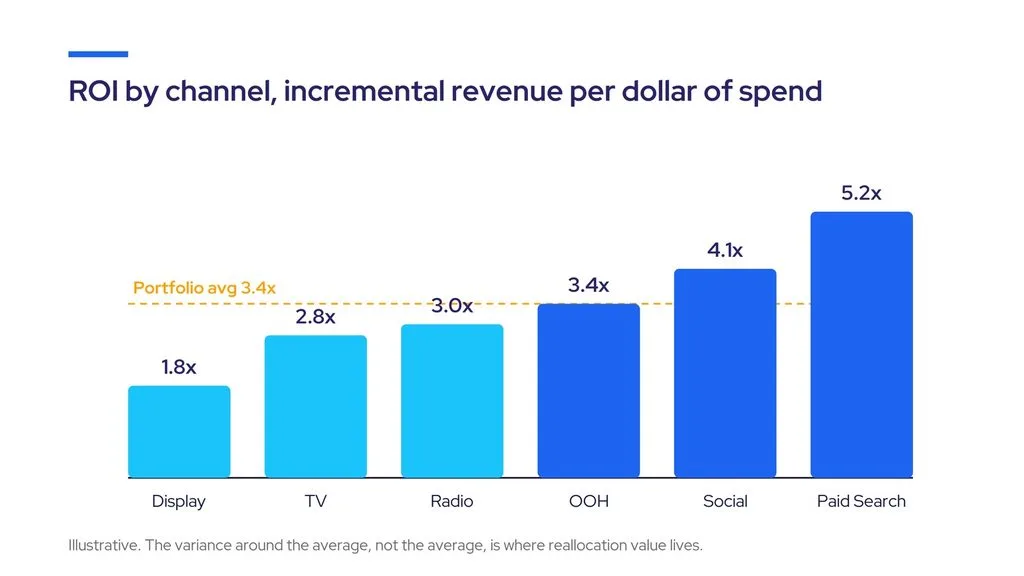
Start with the portfolio view. Across a typical media mix the average return sits somewhere around 3.0x to 3.5x, with individual channels spread widely on either side of it. That spread is the point. The variance is where the budget decisions live.
Now go inside the mix. In consumer goods, the MASS Analytics Benchmark Database shows television delivering immediate ROI in the range of 0.23x to 0.72x across brands in France, Germany, and the UK, while paid search in the same markets returns 6.5x to 13x. Both belong in the model. Television builds the baseline of demand that search then harvests. Judging the two on the same target number would be a category error.
Time horizon shifts the picture again. In financial services, Profit Ability 2 found short-term blended media ROI below breakeven, at roughly 0.94 pounds per pound invested. Read only that number and you would cut brand spend. Include the sustained long-term effect and the blended return rises to about 1.95, because the long-term multiplier for the sector is close to 2.0. The same spend, measured over a different window, flips from a loss to a clear return. A consumer health brand saw the same flip: its brand media returned $2.30 per dollar once long term effects were counted, not $1.00, as this brand vs performance marketing case study shows.
In consumer goods, paid search can return 6.5x to 13x while television returns under 1x in the short term. A single good ROI target would mismeasure both.
The highest-ROI channel is rarely where the next dollar should go
This is the mistake that a good ROI number invites, and it is worth walking through with real figures. Optimizing purely on ROI, always feeding the highest-ROI channel, is one of the most common and most costly errors in budget setting.
Take two channels. Television carries 2.0 million dollars of spend and returns 5.0 million in revenue, an ROI of 2.5x. Paid search carries 0.5 million and returns 2.0 million, an ROI of 4.0x. Search has 60 percent higher ROI. The instinct is to move money from television into search.
Watch what happens if you do. Television is generating 3 million dollars more revenue than search on this budget. Move 500,000 dollars from television to search and search will not produce another 2 million, because at 1 million of spend it is operating in a different, less efficient part of its response curve. The extra revenue might be 300,000 dollars, against the larger amount television gives up. The reallocation that looked obvious on the ROI table produces a net revenue loss for the portfolio.
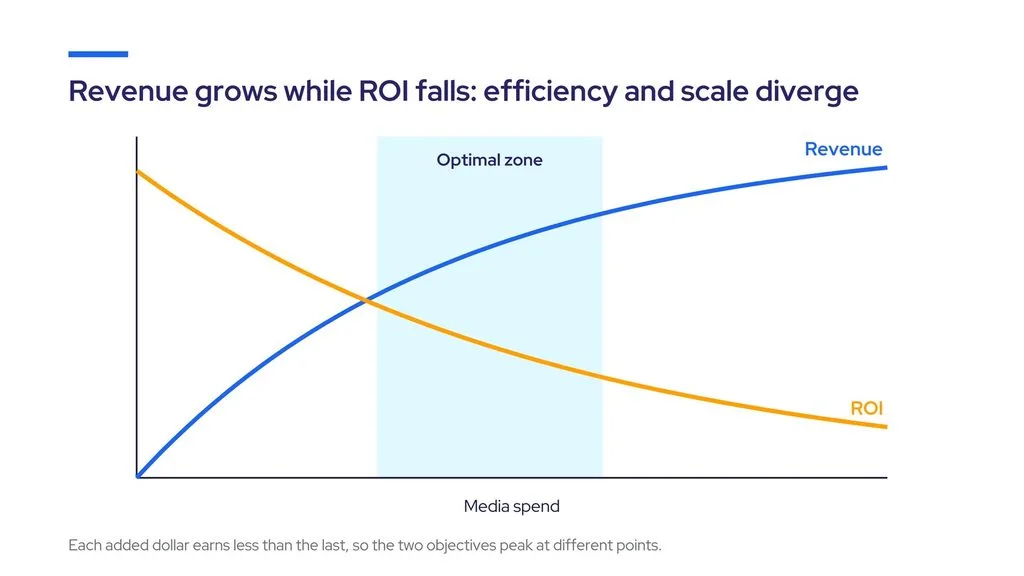
The reason is diminishing returns. As spend in a channel rises, each additional dollar earns less than the one before it, so ROI falls even as revenue climbs. You cannot maximize revenue and efficiency at the same point. The question is never which channel has the highest average ROI. It is where on its own curve each channel is currently sitting, and what the next dollar would earn there.
Moving budget into the highest-ROI channel can lose revenue overall, because that channel earns less on each new dollar than the table implies.
A single blended ROI number hides where the money actually works
By now the problem with a headline ROI figure should be clear. A single blended number, one ROI for all of marketing, averages away the variation that makes the number useful. It cannot tell you which channels need more budget and which are past their efficient point, and those are the only facts that change a budget.
The value shows up the moment you break the number apart. For a global retailer, reallocating across the full portfolio, moving money out of saturated channels and into ones with room left on their curves, lifted media-driven revenue by about 18 percent, roughly 30 million dollars, and moved marketing ROI from 13 to 15.5. The retailer added no extra budget. The gain came entirely from reading the curves correctly.
The same mechanism works at a single-channel level. For a personal care brand, one channel was running at 96 percent saturation, well past the point where extra spend earned its keep. Shifting that trapped budget into channels with headroom raised total media revenue by 5.5 percent on the same total spend. The brand added no new budget. The reallocation simply put the money where the next dollar worked hardest.
A global retailer moved marketing ROI from 13 to 15.5 and lifted media-driven revenue by about 18 percent with no extra budget, purely by reallocating across response curves.
A defensible ROI number is one that came from an incremental model
There is a last question hiding under all of this, and it is the one that matters most in a budget meeting. Is the ROI number real. Simple ROI arithmetic divides revenue by spend, but it does not know which of that revenue the marketing actually caused. Correlation is not contribution. A brand that grew its distribution during the measured period will see its television ROI inflate, because the naive calculation has no way to separate the media effect from everything else moving at the same time.
Separating the two is the job of proper marketing measurement, and specifically what Marketing Mix Modeling does. It isolates the incremental sales each channel drove from base demand, seasonality, promotions, pricing, and competitor activity, so the ROI you report is the part the media genuinely caused. That is what makes the number defensible when finance pushes back. An international airline used exactly this approach to lift marketing ROI by 17 percent while cutting total media spend by 15 percent, a result that is only possible when you know which spend was actually working.
So when you ask what a good marketing ROI is, the more useful question underneath it is whether your ROI number would survive a model that separated cause from coincidence. If it would not, the number you are optimizing against is not yet a number you can trust. For the full method behind this, our Comprehensive MMM Guide is the place to start, and our piece on return on investment in marketing mix modeling goes deeper on the ROI and contribution relationship.
An ROI number is only as trustworthy as the model behind it. If it cannot separate incremental revenue from base demand, it is correlation wearing a ratio.
A single blended ROI number is where most budget mistakes begin.
Frequently Asked Questions
There is no universal figure. Across a typical media portfolio, the average return sits around 3.0x to 3.5x, but individual channels range widely, from under 1x for some brand channels in the short term to well above 6x for efficient performance channels. What counts as good depends on the channel, the sector, and whether you measure short-term or long-term effect.
Marketing ROI divides incremental revenue by media spend, with both expressed in monetary value. If your model output is in units, multiply by average selling price first. If you measure a channel in impressions, convert to spend using the actual buying cost before dividing, so the ratio is comparable across channels.
ROAS, return on ad spend, typically divides total attributed revenue by spend and often counts revenue the advertising did not cause. Marketing ROI, done properly, uses incremental revenue, the sales the media genuinely drove above base demand. The gap between the two numbers is usually the revenue that would have happened anyway.
No. ROI measures efficiency, not scale. A channel with the highest ROI is often small, and extra spend easily pushes it past its efficient point. Moving budget into it can lower total revenue, because each additional dollar there earns less than the last. The better question is where each channel sits on its own response curve.
They are not comparable on one target. In consumer goods, benchmark data shows paid search returning roughly 6.5x to 13x while television returns about 0.23x to 0.72x in the short term. Television builds the baseline demand that search then converts, so both earn their place in the mix despite very different ROI figures.
Simple ROI divides revenue by spend without knowing which revenue the marketing caused. Marketing Mix Modeling separates incremental sales from base demand, seasonality, promotions, and competitor activity. The MMM number is usually lower and always more defensible, because it reflects contribution rather than correlation.
What To Do Before Your Next Budget Meeting
Stop looking for a single good ROI number to hit. Ask a sharper question instead. Which of your channel ROIs would survive a model that separated the revenue your media caused from the revenue that would have arrived anyway. The channels whose numbers hold up are the ones you can defend. The ones that do not are where your next budget conversation should start.
Key Takeaways
- There is no universal good marketing ROI. It depends on the channel, the sector, and the time horizon you measure over.
- ROI measures efficiency, not scale, so the highest-ROI channel is rarely the one to over-fund.
- Real benchmarks vary widely: consumer-goods paid search can return 6.5x to 13x while television returns under 1x in the short term.
- A single blended ROI number hides where the money actually works, and reallocating across response curves can lift revenue with no extra spend.
- An ROI number you can defend is one an incremental model produced, because simple arithmetic cannot separate cause from coincidence.