

Marketing measurement, as MASS Analytics defines it, is how you quantify what marketing produced. Dr. Ramla Jarrar on the measurement signals every stack runs on, and why they only add up inside one model.
- →A plain definition of marketing measurement, and where teams stretch the word until it means nothing
- →The measurement methods every modern stack already runs on, and why I group them into four signals
- →Why any single signal, attribution included, hands you a biased read
- →The job a model does that no dashboard can: turning several partial reads into one decision
- →The question worth asking before you buy another measurement tool
Marketing measurement is the practice of quantifying what your marketing produced: which activity moved which commercial outcome, by how much, and what to change next. It is not a dashboard, and it is not a single number that settles the argument.
Most teams do not have a measurement problem in the sense they think they do. They are not short of data. A mid-sized marketing function today generates more measurement signal in a week than the whole discipline produced in a year a decade ago. The problem is that the signal arrives in four separate systems nobody built to talk to each other, and reconciling them eats the hours the planning cycle needs.
That is the gap this piece is about. Once you can name the four signals and see why each one lies a little on its own, the reason marketing measurement needs a model stops being a vendor talking point and becomes obvious.
A working definition of marketing measurement
Strip away the tool names and marketing measurement answers three questions. What did my marketing produce? How confident am I in that answer? And what should I do differently next quarter because of it?
Those three questions matter in that order. Plenty of teams can produce a number for the first. Far fewer can defend the second when a skeptical CFO pushes on it. Fewer still can connect the answer to a decision that changes where the next pound goes.
Pull the word in two directions and both cause trouble. Pulled one way, it shrinks to whatever a single platform reports, so a team says it measures marketing when it means it reads its ad dashboards. Pulled the other way, it inflates into ‘marketing intelligence’ and stops meaning anything specific. Hold it to the three questions and it stays useful. If you want the mechanics underneath, start with our guide to Marketing Mix Modeling.
A measurement practice that stops at what did marketing produce is reporting wearing a more expensive name.
The four signals a modern measurement stack runs on
Strip the toolkit down and I count four measurement methods doing most of the work in a modern stack. I group them as the four signals, though you will rarely see them named together, because vendors built, sold, and marketed each one as its own discipline. That is why they sit in separate silos rather than one system.
Attribution tracks user-level touchpoints, mostly in digital channels, and tells you which interactions preceded a conversion. Its strength is resolution: it works at user, touchpoint, and platform level, and it refreshes daily or faster. It carries an equally well-documented weakness: the causal claims are weak, the privacy environment keeps tightening, and it is close to blind outside digital. We have written before about how far attribution can mislead when teams trust it on its own.
Experiments, meaning geo-lift and conversion-lift tests, withhold a treatment from one matched group and apply it to another, then read the difference. This is the only one of the four that produces causal proof. When an experiment turns paid search off in matched markets and revenue measurably falls, that observed number closes the argument in a way a model coefficient with a confidence interval cannot. The catch is scope: an experiment tells you about the channel at the moment of the test, in a narrow window, at real cost.
Brand tracking follows the slow-moving measures, awareness, consideration, and preference, usually on a monthly wave. Its commercial payoff shows up over quarters and years, not weeks. This is the signal that stops a system that only sees the next quarter from quietly optimizing away long-term brand investment. In one case study, a consumer health brand used its brand tracker to show that brand media returned $2.30 per dollar, not $1.00.
Creative effectiveness scores the quality of individual executions. Two campaigns with identical spend and identical reach can produce completely different results, and the difference is the creative. Score it at asset level and you turn model noise nobody could previously explain into a measurable driver in its own right.
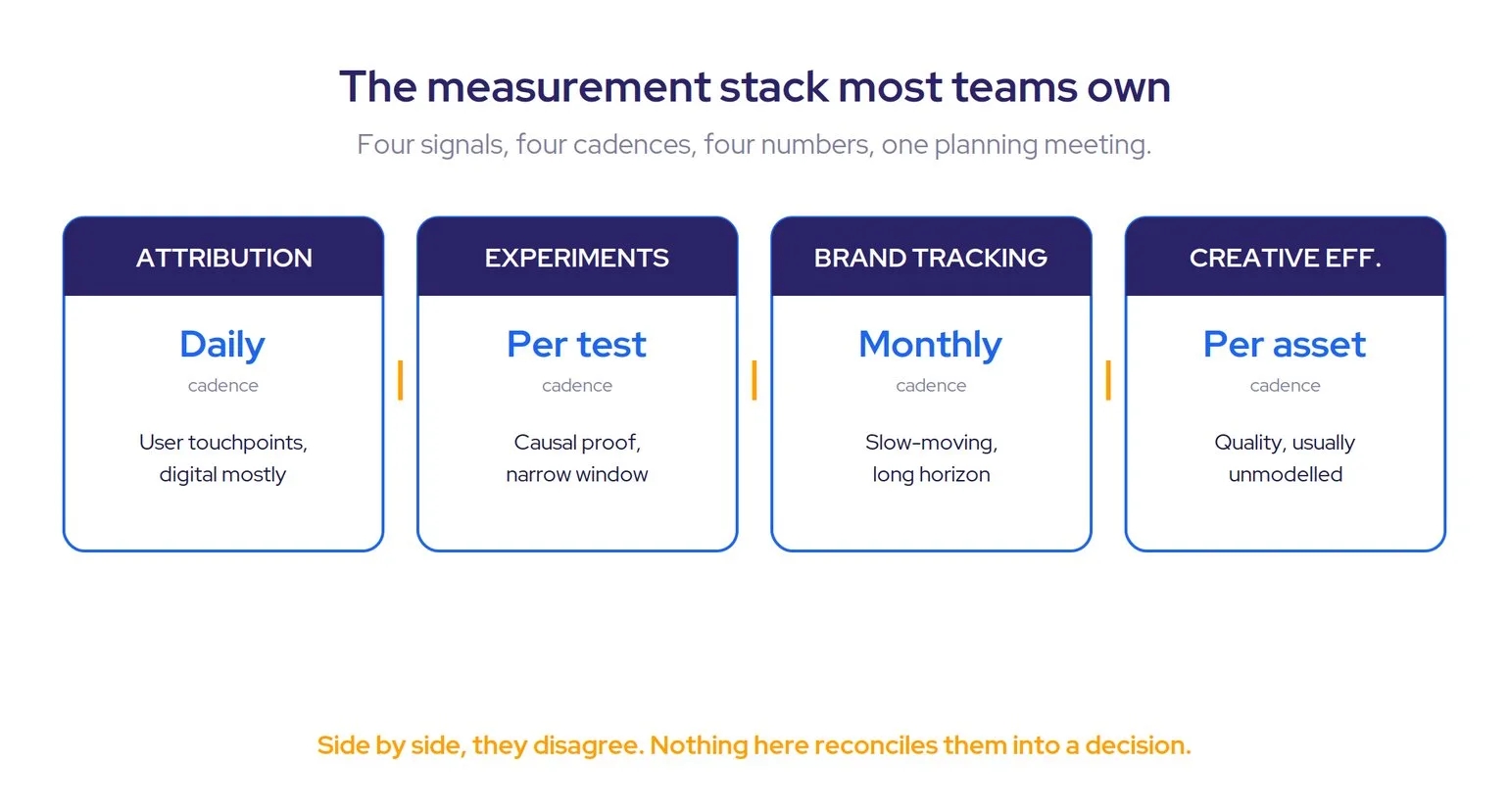
Attribution, experiments, brand tracking and creative scoring each grew up as its own discipline, with its own vendor and its own idea of what counts as proof.
Why one signal always gives you a biased read
Here is the uncomfortable part. Every one of those four signals carries its own bias, and the most dangerous bias belongs to the one most teams lean on hardest.
Attribution over-credits what it can see. It sees clicks and digital touchpoints, so it hands the credit to the digital tactics sitting closest to the conversion and stays silent on the brand and offline activity that built the demand in the first place. A CMO who plans from attribution alone over-invests in the channels attribution can measure and starves the ones it cannot. The number is not wrong so much as partial, and partial in a consistent, expensive direction.
The market knows something is off. Marketing Week’s Language of Effectiveness 2026 study, run with Kantar and Google across more than 600 brand marketers, found that 71.7% of marketers let ease of measurement dictate how they allocate budget. The study states that bias out loud: spend follows what is easiest to measure, not what moves the business most. The same study found that 47.9% of brands have no mechanism to measure creative impact at all, so one of the four signals is missing before the argument even begins. It is a function proving value with instruments nobody built to give a whole answer, a point we have made about why single-signal measurement misleads.
Stacking the four signals side by side does not fix it either. When the readings disagree, the planning conversation slows to a crawl while everyone argues about which number to believe. When they happen to agree, nobody is sure whether the agreement is real or a coincidence.
Four dashboards next to each other is not measurement. It is four opinions and a meeting.
The model is what turns four partial reads into one decision
This is the point where marketing measurement stops being a collection of tools and starts needing a model. A Marketing Mix Model is the framework that holds the four signals in correct relation to one another. It does not average them, and it does not pick a winner. It gives each signal the job it is actually good at.
Experiments enter as calibration anchors: you tune the model to reproduce the lift a test measured, pinning its coefficients to reality at the points you directly observed, and it extends that reading to the times and conditions no single experiment could cover. Attribution enters as directional signal at a granularity the model cannot reach on its own. Brand metrics enter as the long-horizon variable that keeps base demand’s credit from going to whatever short-term line happened to move with it. Creative quality enters as a weight on media exposure.
The output is not four answers to one question. It is four pieces of evidence about four different questions, reconciled into a single coherent read the planning team can carry into the next decision and defend line by line. That is what integrated marketing measurement actually means, and it is why the model sits at the center rather than alongside the others as just another dashboard.
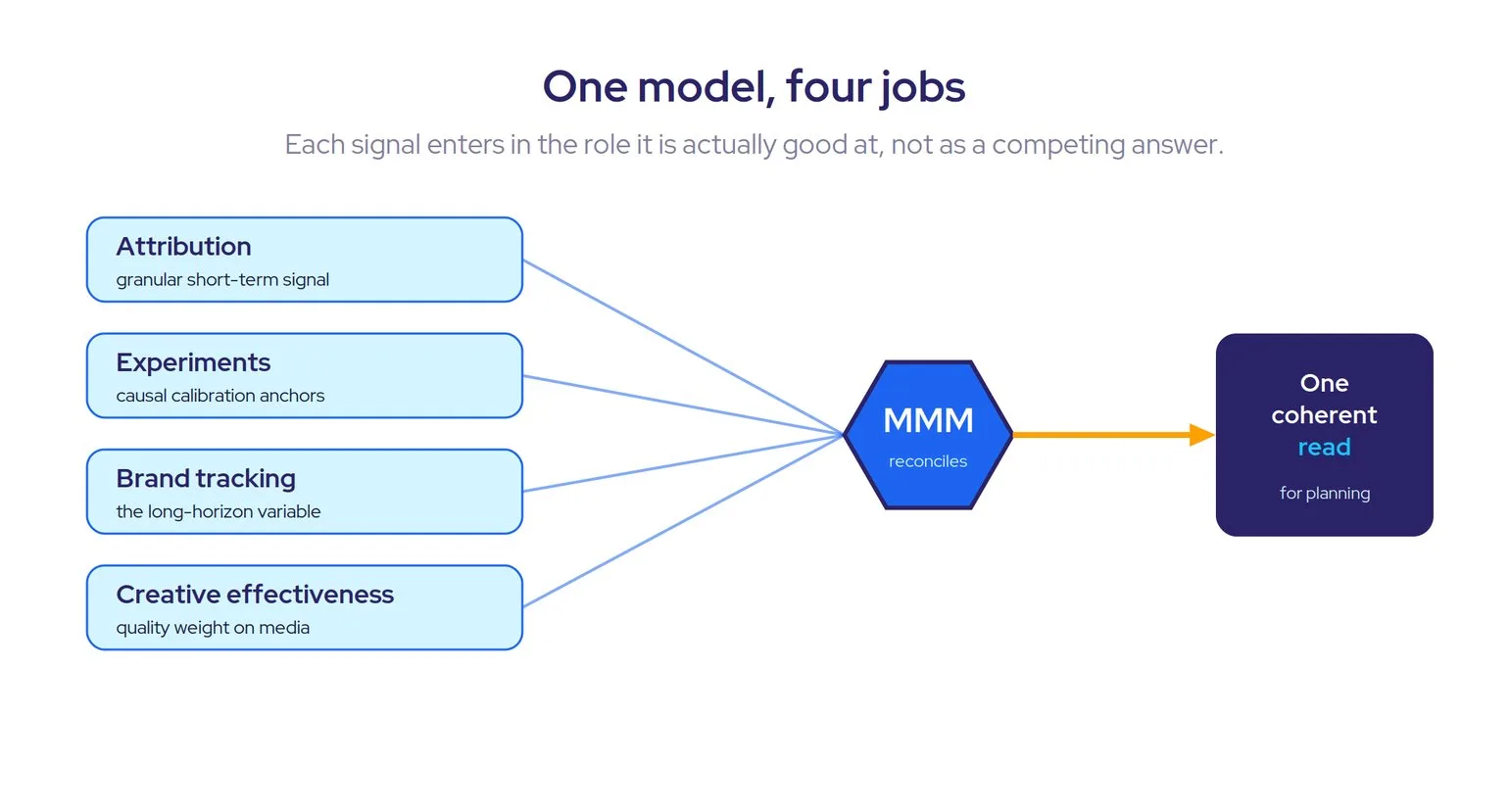
None of this is a new idea. Practitioners have argued for reconciling attribution, experiments, brand, and creative inside one framework for years. What changed is that the data finally caught up: broader channel coverage, finer granularity, and cleaner infrastructure removed the constraints that used to make integration impractical. The limiting factor now is discipline, not availability. The fundamentals of Marketing Mix Modeling set out how you build that framework.
A model does not average the four signals or pick a winner. It gives each one the single job it is good at.
Four signals run on four clocks, which is why cadence decides whether this works
The theory of integrated measurement is straightforward. The practice is hard, and the hard part is not the maths. It is the calendar.
Attribution updates daily. Experiments report whenever they conclude. Brand trackers land monthly or quarterly. A traditional MMM, refreshed once or twice a year, was always the slowest clock in the system. Combining four signals running on four different cadences into one answer used to be close to impossible, because by the time the team rebuilt the annual model against the latest inputs, those inputs had already moved on.
That is the real argument for an always-on model rather than a periodic one. Always-on here means the reconciliation keeps pace with planning. The model rescores on a weekly or monthly cadence, recalibrated against experiments as they land and reflecting price and the other real drivers, so the four clocks feed one answer current enough to act on. Refresh on the cadence the decision runs on, not the cadence the fastest dashboard happens to update. Without that, integrated measurement is a good diagram that never survives contact with a real planning cycle.
The barrier to integrated measurement is no longer data. It is cadence.
Marketing measurement, common questions
It is quantifying what your marketing produced, how confident you are in that figure, and what to change next. In practice it means combining several measurement signals, attribution, experiments, brand tracking, and creative scoring, into one read on which activity drove which commercial outcome, rather than trusting any single platform’s version.
Attribution feeds measurement as one input, not a synonym for it. Attribution tracks digital touchpoints at user level and credits the interactions near a conversion. Measurement is the wider practice that places attribution alongside experiments, brand data, and creative quality inside a model, so the model corrects the digital-only, short-term bias in attribution rather than trusting it on its own.
Each individual signal carries a bias in a known direction, and stacking them side by side does not remove it. A model assigns each signal the role it is good at and reconciles them into one coherent answer. Without a model you have several dashboards that disagree, which is a set of opinions rather than a decision.
The four that dominate modern stacks are attribution, incrementality experiments, brand tracking, and creative-effectiveness scoring, with Marketing Mix Modeling as the framework that integrates them. Each answers a different question: short-term digital detail, causal proof, the long horizon, and quality differences at equal spend.
Agree one framework and one calendar before agreeing on tools. The recurring failure is not a missing metric, it is four teams reporting four cadences with no shared model to reconcile them. Fix the reconciliation layer, usually an always-on model, and cross-team measurement becomes a single answer everyone works from instead of a standing argument.
No. A dashboard displays what already happened in one system. Measurement explains what your marketing caused across systems and tells you what to change. A dashboard can be an input to measurement, but a wall of dashboards is not a substitute for a model that reconciles them.
The question worth asking before your next budget meeting
So the honest question for most teams is not are we measuring marketing. You almost certainly are, in four places at once. The question is whether anything reconciles those four reads into one decision, or whether that reconciliation still happens in someone’s head in the budget meeting, under time pressure, with the four numbers disagreeing. If it is the second, you do not need another tool. You need a model at the center. Which of your four signals is currently setting the budget on its own, and would it survive a check against the other three?
- ✓Marketing measurement answers three questions in order: what did marketing produce, how confident are you, and what should change. A practice that stops at the first is reporting, not measurement.
- ✓Modern measurement runs on four signals: attribution, experiments, brand tracking, and creative effectiveness. Each is genuinely useful, and each carries its own bias.
- ✓Attribution’s bias is the costly one. It over-credits digital activity it can see and stays silent on the brand and offline demand it cannot, so planning from it alone skews spend in one direction.
- ✓A model earns its place by reconciling the four signals into one defensible answer, giving each the role it is good at rather than averaging them or picking a favorite.
- ✓The barrier to integrated measurement is now cadence, not data. Four signals on four clocks need continuous calibration to feed a single answer current enough to plan against.