

Can small brands run marketing mix modeling? MASS Analytics explains what MMM actually requires, and why brand size was never on the list of criteria.
- •The pricing history behind the “MMM is enterprise-only” assumption
- •What a regression model actually needs from your data, and why revenue is not on the list
- •A readiness framework comparing enterprise-era assumptions with the real minimums
- •The pooling technique that multiplies observations without waiting extra years
- •Three routes into MMM for a smaller brand, with the trade-offs stated plainly
Marketing mix modeling has a data threshold, not a size threshold. It is a question we hear constantly from small business and mid-size marketing teams. We have watched brands with eight-figure media budgets fail an MMM readiness check, and brands a tenth of their size pass it comfortably. The difference was never revenue. It was the shape of their data.
The question still arrives every week, on Quora, on Reddit, in our inbox: “We spend two million a year on media. Are we too small for MMM?” It is one of the most persistent assumptions in marketing measurement, and it deserves a direct answer rather than a hedge.
The enterprise-only reputation is a pricing artifact
MMM grew up inside the world’s largest consumer goods companies. For decades it was delivered the same way: a specialist consultancy, a project running eight to sixteen weeks, and a fee structured like a capital investment. Under that delivery model, only companies with very large media budgets could justify the cost. The reputation followed the price tag.
Now look at what the method actually is. MMM is a regression built on aggregate weekly data: sales on one side; media, price, promotions, and external factors on the other (we walk through the basics in Marketing Mix Modeling 101). Nothing in that mathematics checks your company size. There is no minimum revenue term in the equation.
MMM has a data threshold, not a size threshold. The method never asked how big your brand is. The old delivery model did.
What changed is the delivery layer. Automated data preparation and automated model building have compressed what used to take a quarter into days. We have delivered a full MMM project for an FMCG brand, complete with saturation and synergy analysis, in approximately seven days. When the effort collapses, the price collapses, and the enterprise-only argument collapses with it.
The model wants variation, not volume
A regression estimates a channel’s effect by watching what happens to your KPI when activity on that channel changes. That single sentence carries the entire readiness question. The model learns from movement, and it does not care who is moving (the mechanics are in What Is Marketing Mix Modeling, and How Does It Actually Work?).
The standard recommendation is three years of weekly data, roughly 156 observations, enough to cover two full seasonal cycles and several promotional waves. Alongside that history, three inputs matter far more than budget size: media activity that varies (flights, bursts, on and off periods), one clean weekly KPI, and a documented promotional calendar. The full data requirements are covered in the Comprehensive MMM Guide.
A regression does not know your revenue. It knows whether your media activity varied enough to leave a signal in your sales data.
Here is the part that rarely gets said: smaller brands hold real structural advantages. A mid-size brand typically runs four to eight channels, not twenty-five. Fewer channels means less multicollinearity (channels moving in lockstep, which makes their effects hard to separate), and that means cleaner, more defensible estimates. The data usually sits in two systems rather than twelve, so there is no six-month archaeology phase. And the decision loop is shorter: when the model says shift budget, a mid-size brand can act within weeks. The genuine blocker, when there is one, is flatness. If you have spent the same steady amount on the same two channels every week for two years, the model has nothing to learn from. The fix is not more budget. It is deliberate variation.
A readiness framework: enterprise assumptions against actual minimums
Most readiness conversations we have with smaller brands end up correcting the same six assumptions. The table below is the framework we use. Read the middle column as the actual entry bar, and the right column as the work plan if you fall short.
| Readiness dimension | The enterprise-era assumption | What the model actually needs | If you fall short |
|---|---|---|---|
| Media budget | Eight-figure annual spend | Spend that varies enough to leave a signal across three to eight channels | Introduce deliberate flighting; flat always-on spend is the real blocker, not the spend level |
| Data history | Five or more years of archives | Two to three years of weekly KPI and media data | Start logging now, and pool across regions or stores to compress the calendar |
| Channel count | Fifteen or more channels | Three to eight consistently measured channels | Treat it as an advantage: fewer channels mean less multicollinearity |
| KPI structure | A nested tree of KPIs by product and market | One clean weekly outcome: sales, orders, or sign-ups | Pick the KPI closest to money and resist splitting it in year one |
| Team | An in-house data science unit | One analyst who owns the data, plus a modeling layer you buy | Keep data ownership internal; buy the modeling layer rather than building it |
| Cadence | A big annual study | An annual baseline first, refreshed quarterly once stable | Do not chase a weekly refresh before the first model survives validation |
None of the rows in this table says, “be a bigger company.” Every genuine gap has a remedy measured in months of discipline, not years of growth.
Pooling multiplies observations when history is short
The most common real gap is history: the brand started collecting clean data 18 months ago and does not want to wait another 18. This is where pooled regression earns its keep. Instead of modeling one national time series, you model across cross-sections (regions, stores, customer segments) simultaneously.
The arithmetic is dramatic. Eighteen months of national weekly data carry 78 observations. The same 18 months across six regions carry 468 region-weeks, statistically comparable to a three-year national dataset. Seasonal events multiply too: pool five regions over three years and Christmas appears fifteen times in your data instead of three.
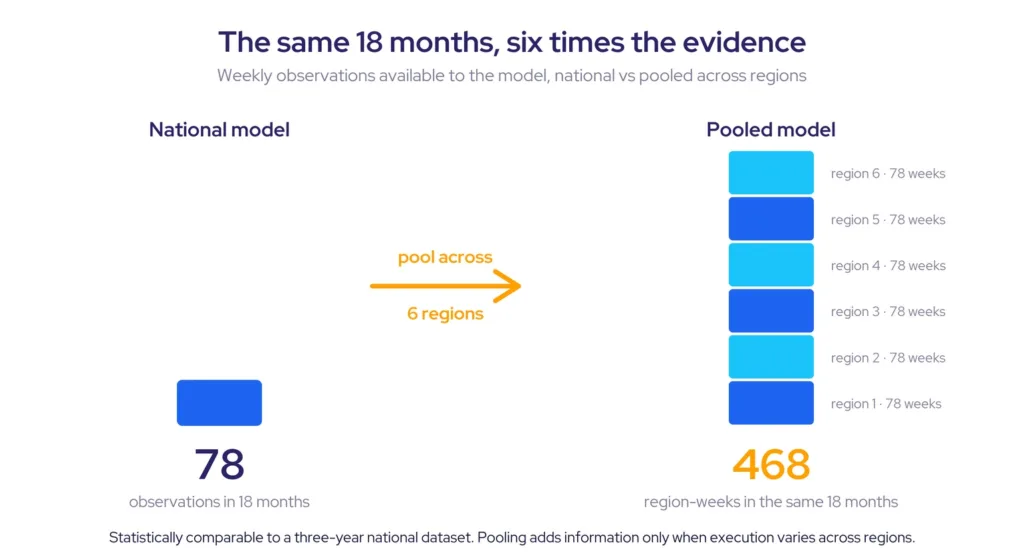
One caveat, and it matters: pooling only helps when execution varies across the cross-sections. Identical media weight in every region adds rows but no new information. For the deeper mechanics of extending models across markets and segments, see How Far Can You Scale with Marketing Mix Modeling.
Eighteen months of weekly data across six regions carries 468 region-weeks of evidence. That is statistically comparable to a three-year national dataset.
Three routes in, priced honestly
A smaller brand entering MMM today has three realistic routes, and we describe them here the way we would to a peer rather than a prospect.
The consultancy route buys advisory depth and methodological rigor, and the strongest firms offer judgment no software substitutes for. The trade-offs: high fixed cost, quarterly or annual cadence, and a methodology that stays vendor-side. You rent the capability. You do not build it.
The open-source route (Meta’s Robyn, Google’s Meridian, PyMC-Marketing) has done the industry a service by making serious Bayesian methods freely available. It is free on the licensing line and expensive on the engineering line: someone has to build the data pipelines, maintain the infrastructure, and hold the specialist expertise to configure the models responsibly. For a brand without a data science team, the hidden cost usually exceeds the visible one. We compare the two approaches in MassTer PACE vs Open-Source MMM.
The platform route pairs an always-on modeling engine with a thin advisory layer, running inside your own data environment. This is the route we built MassTer PACE for, so read our view on it with that in mind, but the structural argument stands on its own: cost scales with cadence, and the capability transfers in-house over time instead of staying with the vendor. If you want to see what a tightly scoped project looks like in practice, start with this sales drivers analysis case study.
Open-source MMM is free on the licensing line and expensive on the engineering line. Someone has to own the infrastructure.
Where smaller-brand MMM goes wrong
The failure modes of this size are predictable, and all four are avoidable.
Overspecification is the classic. Twenty variables estimated on 100 observations is not a model, it is a wish. Start with your main channels, price, promotions, and seasonality. Earn complexity.
Splitting too early is its cousin. One clean KPI, modeled well, beats five fragmented ones modeled poorly. Resist splitting by product line or channel detail until the aggregate model has proven stable.
Judging MMM against platform ROAS is the third trap. Your first model will disagree with your ad platform dashboards, and that disagreement is the point: they measure different things. We wrote a full piece on why MMM vs. MTA is the wrong fight, because the two answer different questions, and a smaller brand needs that distinction settled before the first results meeting, not after it.
And finally, treating the first model as the final answer. Your first MMM is a baseline. Its job is to survive validation, reset your assumptions about two or three channels, and become the foundation you refresh. Cadence is earned, not installed.
Do not chase a weekly refresh before one model has survived a full validation cycle. Cadence is earned, not installed.
Frequently Asked Questions:
Yes, provided the data supports it. A small business with two to three years of weekly sales data, three or more media channels that vary in activity, and a documented promotional calendar can build a defensible MMM. Brand size is not a model input. Data history, spend variation, and KPI cleanliness are the actual criteria.
There is no hard budget floor written into the method. The practical requirement is that spend varies enough to leave a measurable signal in sales across a handful of channels. A brand spending one to two million dollars a year with deliberate flighting is often more model-ready than a larger brand spending flat, always-on budgets.
The standard recommendation is three years of weekly data, which captures two full seasonal cycles. Two years can be sufficient when the model pools across regions, stores, or segments, because cross-sections multiply the effective number of observations and compress the calendar requirement.
They answer different questions and are not substitutes. Attribution traces individual digital journeys. MMM measures the incremental contribution of every channel, including offline, at the budget level. For budget allocation decisions, MMM is the appropriate tool at any brand size.
Yes, and the packages themselves are credible. The realistic cost sits in everything around them: data pipelines, infrastructure, validation discipline, and the specialist expertise to configure priors and transformations responsibly. Budget for engineering time, not license fees, when comparing this route against platforms or consultancies.
A traditional consultancy workflow runs eight to sixteen weeks. Automated platforms compress this substantially: we have delivered a complete project, including saturation and synergy analysis, in approximately seven days. Data readiness is usually the real timeline driver, not the modeling itself.
The question to take into your next budget meeting
If you run a small or mid-size brand, the question is not whether you are big enough for MMM. It is whether your data is ready. And if it is not, the remedies are within your control this quarter: introduce variation into your flighting, consolidate your KPI, start logging promotions properly (Learn Marketing Mix Modeling maps the practitioner path). Six months of that discipline puts you in front of a model that most brands twice your size could not have built five years ago.
So take this into your next budget meeting: if one of your channels stopped paying for itself six months ago, what in your current measurement setup would have told you?
- •MMM has a data threshold, not a size threshold. The enterprise-only reputation came from how the method was sold, not from the mathematics.
- •Three years of weekly data is the standard entry bar, and pooling across regions or stores can compress it: 18 months across six regions carries 468 region-weeks of evidence.
- •Smaller brands hold structural advantages: fewer channels mean less multicollinearity, cleaner data ownership, and faster action on the model’s recommendations.
- •Choose your route by who owns the capability afterwards: consultancies rent it to you, open source hands you the engineering bill, and always-on platforms transfer it in-house.
- •Start with an annual baseline model and earn your cadence. A first MMM’s job is to survive validation, not to run weekly.