

A perspective from MASS Analytics on why most teams still cannot act on a model output, and the two capabilities that close the gap.
Most teams evaluating marketing budget optimization software are actually facing two decisions, not one. The first is methodological: how does a finished Marketing Mix Model become a tested plan. The second is practical: which tool does that job, what can be configured inside it, and how does enterprise procurement work. This article addresses the second decision.
For the full methodological argument, including why simulation and optimization run in opposite directions and why the plan has to be tested before the spend is committed, see our companion article: From Marketing Mix Model to Optimized Budget Decisions. The analysis here picks up where that one ends, at the point where the team has agreed the workflow and is choosing the tool that runs it.
MassTer Mind is that tool. What follows covers the specific capabilities it puts at a planner’s fingertips: the planning rules, the budget sufficiency question most teams never ask, how Maia runs the optimization, and how to bring it in through AWS Marketplace against an existing enterprise procurement.
Two questions, one boundary
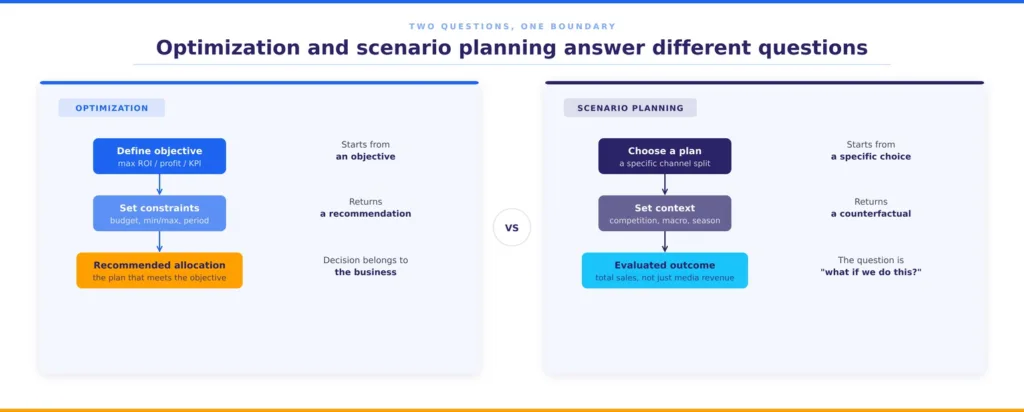
Once a Marketing Mix Model is built and trusted, it can answer two forward-looking questions. They sound related. However, they are not.
Optimization asks what allocation is best for the budget you have. Under your constraints (total spend, date range, channel floors and ceilings) it returns the plan that best meets your objective. It is a recommendation.
In contrast, scenario planning asks what happens if you do something specific instead: a different channel split, a new market, a step change in spend, a competitor doubling their budget. It returns an evaluated outcome, not a recommendation. The answer is contingent on the choice you are testing.
Blur the two and the model answers a question nobody asked. Keep the boundary clean and the numbers serve the decision. The model does the arithmetic. The decision stays with the business.
For the full methodological argument behind that boundary, see our companion article, From Marketing Mix Model to Optimized Budget Decisions. For the optimization mechanics themselves (the diminishing returns curves, the greedy increment algorithm, and marginal ROI), see our piece on optimization mechanics. And for how MMM optimization works end-to-end, see the technical reference.
The question most planning rounds skip
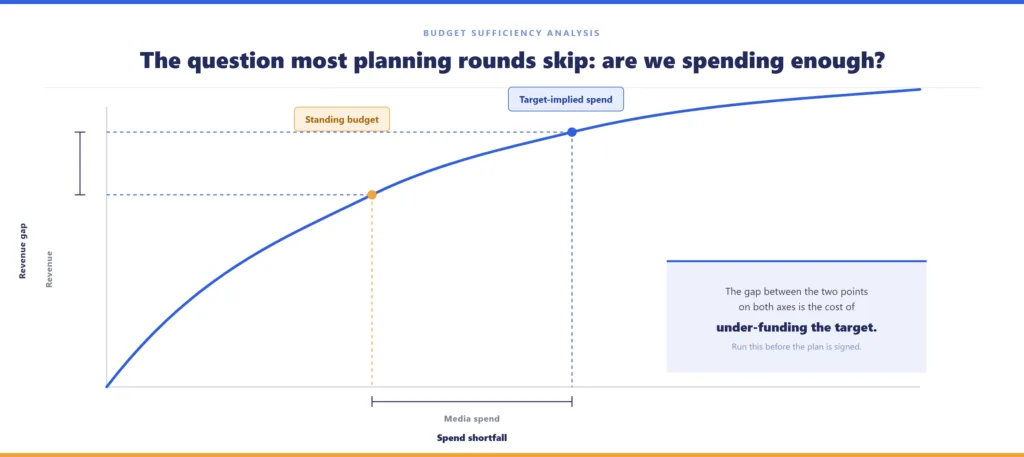
There is a third question that should precede both optimization and scenario planning, and almost never does: are we spending enough.
Under-spending is the most expensive mistake in marketing because it is invisible. A campaign that delivers below its potential does not register as a failure. Instead, it registers as a result. Only a counterfactual, a scenario that funds the plan at the level the target actually requires, makes the cost visible before the planning round closes rather than after the year does.
This is budget sufficiency analysis. First, name the revenue target. Then, read the spend level consistent with reaching it against the current response curves. If the standing budget sits below that level, the gap is the cost of under-funding. Most teams discover this in the post-mortem. A planning engine surfaces it in the planning round.
For example, one global automotive group runs budget sufficiency as standard ahead of every model-year planning round. The recurring question is not how to redistribute the existing budget, but whether the planned spend is consistent with the volume target the business has committed to. When the answer is no, the conversation moves up the chain before the campaign launches.
Where the decision gets made: MassTer Mind
MassTer Mind is the optimization and scenario planning engine inside the MassTer platform. It is the place a business user (a marketer, a finance lead, a media planning director) who works to turn a Marketing Mix Model into a budget decision, without touching the methodology underneath.
First, move spend between channels. Then, test a scenario. Finally, lock the plan against the model’s response curves. All of it in minutes, with no code and no queue on a data scientist. In addition, MassTer Mind works with models teams build in MassTer’s proprietary format and with Meridian, the open-source standard from Google. The modeling approach you trust stays in place. As a result, Mind turns its output into a live planning tool.
What you can control in a scenario
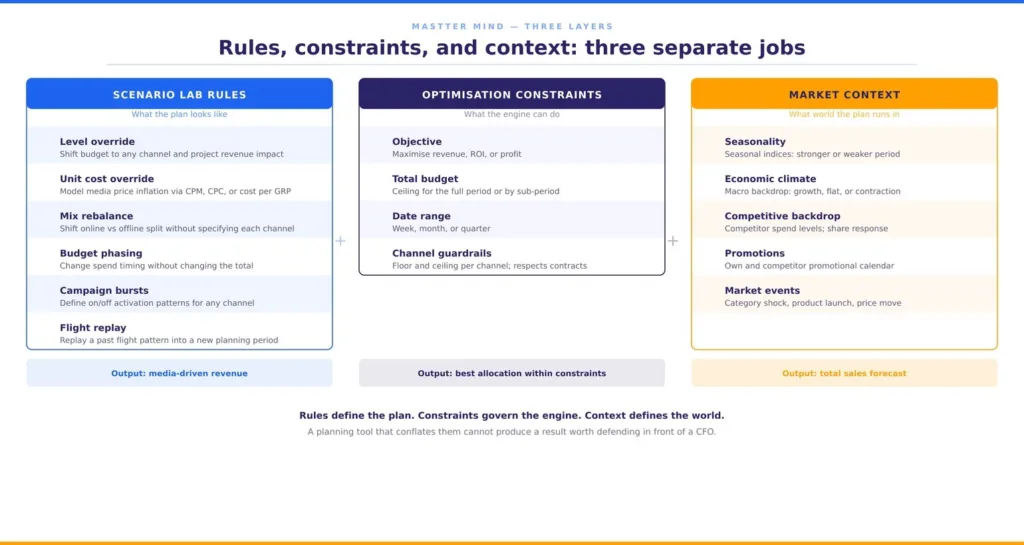
MassTer Mind separates three distinct things that most planning tools collapse into one: the media plan rules, the optimization constraints, and the market context. Specifically, each does a different job. Conflating them produces a plan that is internally inconsistent. In contrast, keeping them separate is what makes the output defensible.
First, the six Scenario Lab rules define the shape of the media plan itself: how the team levels, costs, mixes, phases, and flights channels within it. Second, the optimization constraints define the boundaries the engine works within: total budget, date range, and channel-level guardrails. Third, the market context defines the world the plan runs in: seasonality, macroeconomic conditions, competitive backdrop, promotions, and market events. Together, run the six rules and the optimization engine and you get media-driven revenue, the best allocation under your plan and constraints. Finally, compose that result with context at the Strategy stage and you get total sales: what that allocation produces in a specific version of the world. Ultimately, that is the number a CMO is actually accountable for.
| Lever | What you can set |
|---|---|
| Total budget | Set a ceiling for the full period or by sub-period |
| Channel min / max | Floor and ceiling per channel, respects contracts and inventory commitments |
| Objective | Maximize revenue, maximize ROI, maximize profit, or a custom KPI |
| Time period | Week, month, or quarter, matching your plan’s actual cadence |
| Channel synergies | Account for multiplicative effects between channels in the same model |
| Economic climate | Adjust the macro backdrop: growth, flat, or contraction |
| Competitor activity | Set competitor spend levels to see how your share responds |
| Promotions | Overlay a promotional calendar, own and competitor |
| Seasonality | Apply seasonal indices to test peak vs off-peak scenarios |
| Market events | Model one-off events: a category shock, a product launch, a price move |
The constraint rules matter for a practical reason: real plans carry commitments the algorithm has no way of knowing. A channel with contracted inventory has a ceiling. Similarly, a brand with a minimum share-of-voice requirement has a floor. Likewise, a portfolio objective weighted toward margin rather than revenue needs a different optimizer. Setting those constraints before the optimization runs means the output is a plan the business can actually execute, not an academically optimal allocation that collapses on contact with the agency brief.
The six rules available inside MassTer Mind cover the full range of decisions a planning round typically requires. The example above used three of them. The other three, however, are equally applicable.
Rules stack. A plan that carries a unit cost override for television inflation, a mix rebalance to grow digital share, and a budget phasing shift to weight spend toward the peak quarter is one scenario, not three. That is what makes the output a plan the team can recognize, rather than a theoretical allocation built in a vacuum.
The context levers work differently: the Scenario Lab doesn’t apply them. Instead, the Strategy stage composes them, testing the optimized media plan against different versions of the world: stronger or weaker seasonality, different macroeconomic conditions, different competitive pressure. This is where media-driven revenue becomes total sales, and where the team stress-tests the plan before committing the budget.
Maia: the AI agent working the scenarios
At the center of MassTer Mind is Maia, the AI agent that runs across the full MassTer platform. Specifically, inside Mind, Maia does the work that makes scenario planning usable at speed rather than just theoretically possible.
The distinction that separates MassTer Mind from a standard optimizer is the move from a single forecast to a range. First, an optimized scenario produces media-driven revenue, the best allocation of your budget given the conditions the model reflects. Then, a strategy takes that same optimized plan and runs it through different versions of the world. The output is not a single number. Instead, it is a range: total sales under a stronger season and total sales under a weaker one. A range is what leadership can plan against, defend in front of a CFO, and update when the world moves. A single forecast, however accurate, cannot do any of those things.
In other words, optimized media plan plus context equals total sales. The media plan answers what the best allocation is. The context answers what world that plan runs in. The combination answers the question a CMO is actually accountable for.
The number of valid budget allocations across ten channels, six time periods, four constraint types, and two context dimensions is not a number a planner can evaluate manually. Instead, Maia works through that space and surfaces the best-supported conclusion, not just a defensible one. There is a difference. Specifically, a defensible answer is one that holds up to challenge. The best-supported answer is the one that would hold up even if the challenger had access to the same data and the same model.
Inside a planning session, Maia flags where spend is past saturation before the optimizer runs, so the team knows which channels are unlikely to earn their next increment regardless of how the team sets the budget. In addition, it identifies where the standing plan is leaving marketing return on the table: channels with room on the curve it’s under-funding. And when the plan is ready, it runs the constrained optimization across all the rules the team has set, returning an allocation that meets the objective within every constraint simultaneously.
The guardrails matter. Specifically, the team sets the approval thresholds, the protected budgets, and the activation scope. Maia recommends within those boundaries. Consequently, the result is a planning process that runs at the speed the market moves. Each plan feeds into MassTer PACE for real-time tracking, performance feeds back, and the next plan starts from a sharper model than the last.
For Maia in depth, including how it operates the full modeling loop across Flow, Studio, Mind, and PACE, see our extended look at the agent.
What this looks like in practice
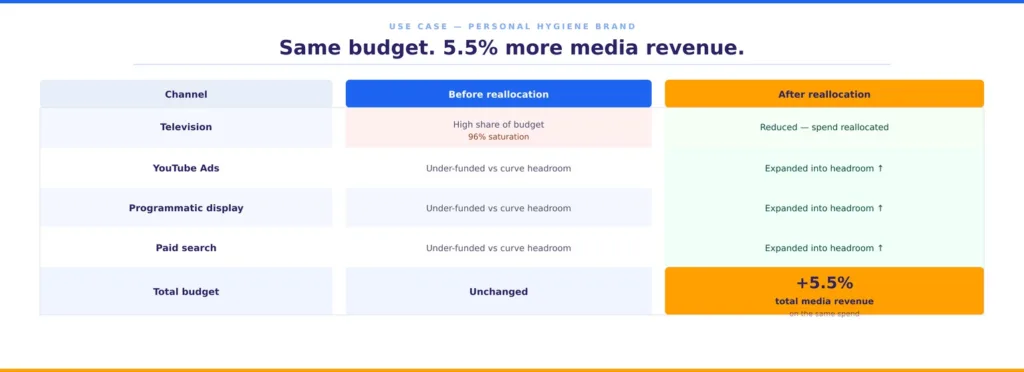
A major personal hygiene brand ran across digital and television, with the budget shaped largely by prior patterns. Television was assumed to be working hard. However, whether it was still earning its share at the margin was not something the planning round could see.
The team ran an optimal execution range analysis against the model’s response curves inside MassTer Mind. The analysis identified television at 96% saturation, well into diminishing returns. So the team moved spend out of television and into YouTube Ads, programmatic display, and paid search, grounding each decision in the curves rather than intuition. The total budget did not change.
As a result, total media revenue rose 5.5% on the same spend. Three digital channels grew into model-derived headroom. The reallocation was not an intuition call. Instead, it was the direct output of the response curves, tested in the planning tool before a pound of budget moved.
Procurement: MassTer Mind and Managed MMM Consultancy on AWS Marketplace
If your team is evaluating the Managed Consultancy as an entry point, see Walk, Run, Fly: the MASS Analytics pathway from managed delivery to in-house capability.
Both MassTer Mind and the MASS Analytics Managed MMM Consultancy are available through AWS Marketplace. In fact, for enterprise teams whose procurement runs through AWS, both can be brought in against an existing AWS commit. This is the same mechanism used for other platform tooling, with private offers handling negotiated enterprise pricing, commercial terms, and currency specifics directly.
This matters practically for teams that want to start with a Managed MMM Consultancy engagement (a fully supported, MASS-delivered program) and move to an in-house capability built on MassTer Mind over time. Therefore, both steps sit on the same procurement vehicle. There is no need to open a separate vendor relationship at the point of transition.
On security and compliance: MASS Analytics holds ISO 27001 certification, and as an AWS Marketplace seller has passed AWS’s vendor verification process. For enterprise buyers, that means a procurement path that is both commercially consolidated and independently vetted. Security and compliance documentation.
Frequently asked questions
They answer different questions. Specifically, optimization finds the best allocation for the budget you already have, under your constraints, and returns a recommendation. In contrast, scenario planning asks what happens if you choose a specific alternative and returns an evaluated outcome. A complete planning tool does both and keeps the boundary clean between them.
Budget sufficiency analysis answers the question most planning rounds skip: is the planned spend consistent with the revenue target the business has committed to. It names the target, reads the spend level required to reach it against the current response curves, and makes the gap visible before the team signs the budget. Most teams discover a sufficiency gap in the post-mortem. Instead, a planning engine surfaces it in the planning round.
Three separate layers, each doing a different job. First, the six Scenario Lab rules (Level Override, Unit Cost Override, Mix Rebalance, Budget Phasing, Campaign Bursts, Flight Replay) define the shape of the media plan itself. Second, the optimization constraints (objective, total budget, date range, channel guardrails) govern what the engine can do when finding the best allocation. Finally, the market context (seasonality, macroeconomic conditions, competitive backdrop, promotions, market events) enters at the Strategy stage: this is where the team composes an optimized media plan with a specific version of the world to produce a total sales forecast rather than a media-driven revenue projection.
Maia is the AI agent at the center of the MassTer platform. Inside MassTer Mind, Maia works through thousands of possible budget allocations and surfaces the best-supported conclusion within the constraints the team has set. It flags saturation before the optimizer runs, identifies where the standing plan is leaving marketing return on the table, and runs the constrained optimization across all rules simultaneously. The decision stays with the business. Ultimately, Maia makes sure the model backs it.
Yes. MassTer Mind is model-agnostic. It works with models teams build in MassTer’s proprietary format and with Meridian, the open-source standard. Teams do not have to rebuild or migrate their model. Instead, the modeling approach they trust stays in place.
Yes. Both MassTer Mind and the MASS Analytics Managed MMM Consultancy are available on AWS Marketplace as private offers. Enterprise teams with existing AWS procurement can bring either or both in against their current AWS commitment. The private offer handles negotiated enterprise pricing and commercial terms directly. MASS Analytics holds ISO 27001 certification and has passed AWS’s vendor verification, giving buyers an AWS-vetted procurement path.
The question for your next planning round
Before you sign the next plan, ask two questions. First, did you run a budget sufficiency check: is the spend you are committing consistent with the target you have committed to reaching? And did that check run against the model’s actual response curves, or against a spreadsheet built on last year’s patterns?
Then ask a third: does your plan carry a range (total sales under a stronger world and total sales under a weaker one) or does it rest on a single forecast that assumes the market holds still?
Anyone can challenge a single forecast. A range with simulated evidence behind both ends is what leadership can plan against and defend. That is what MassTer Mind produces at the Strategy stage: not a number, but a tested interval, and an interval is what a CFO and a board can act on.
Overall, those questions have different answers for most teams. MassTer Mind exists to close the gap between them.
See MassTer Mind and the Managed MMM Consultancy. Both available through AWS Marketplace.